AI Receptionist Cost: What Businesses Actually Pay in 2026
A straight, no-hype look at what an AI receptionist really costs to set up and run in 2026 — and how it compares to a human answering service.
 SprintX Team8 min read
Every missed call is a customer who just called your competitor. That is the real math behind an AI receptionist — not "cool robot on the phone," but "how many booked jobs am I losing to voicemail?" Once you frame it that way, the next question is obvious: what does one actually cost?
The honest answer is that "AI receptionist" covers everything from a $50/month off-the-shelf bot that reads a script to a fully custom voice agent that checks your calendar, books the slot, and texts the caller a confirmation. This guide separates the price into the parts that matter so you can budget without guessing.
The three costs that make up the price
Almost every confusing quote comes from blending these together. Keep them separate:
- Setup (one-time): building the agent, writing its call flows, connecting your calendar/CRM, buying and configuring a phone number.
- Usage (per-minute): the voice AI platform bills for talk time — speech-to-text, the language model, and text-to-speech.
- Retainer (monthly): maintenance, monitoring, and tweaks as your business changes.
A cheap setup with a chatty agent that rambles for four minutes per call can cost more over a year than a tighter build that wraps calls in ninety seconds. Look at all three.
AI receptionist cost by tier
Here is what different levels realistically cost in 2026.
| Tier | Setup (one-time) | Per-minute | Monthly retainer |
|---|---|---|---|
| Off-the-shelf bot (self-serve) | $0 – $300 | $0.08 – $0.20 | $50 – $300 |
| Custom single-purpose agent | $1,000 – $3,500 | $0.07 – $0.15 | $150 – $500 |
| Custom agent + booking + CRM | $3,500 – $9,000 | $0.07 – $0.15 | $300 – $900 |
| Multi-location / multi-flow system | $9,000 – $25,000+ | $0.06 – $0.12 | $800 – $2,500+ |
An off-the-shelf bot is fast to switch on and fine for basic "we're open 9 to 5, here's our address" answering. It struggles the moment a caller goes off-script.
A custom single-purpose agent is built around one job — usually answering and qualifying — with your tone, your FAQs, and a clean handoff to a human when needed.
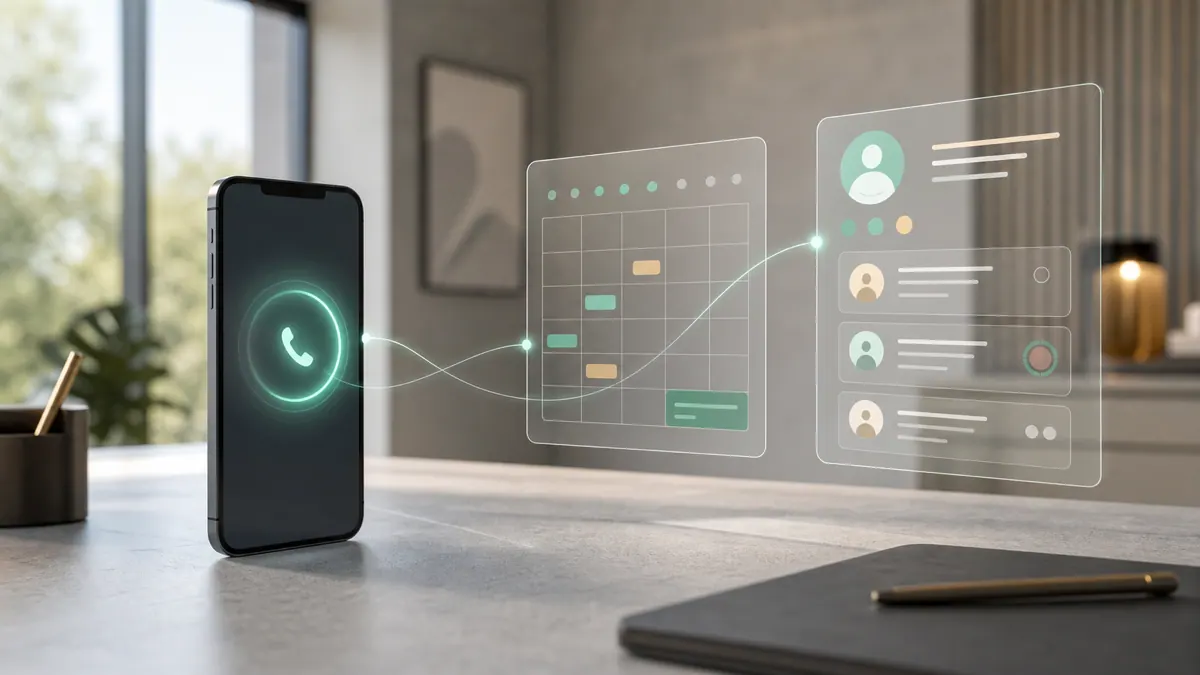
A custom agent with booking and CRM actually does the work: checks live availability, books the appointment, logs the caller in your CRM, and confirms by SMS. This is where most service businesses see real ROI.
A multi-location system routes by branch, handles several call flows (new booking, reschedule, billing question), and reports across sites.
What per-minute pricing really means
The platforms most agencies build on — Vapi, Retell, and similar — bill by the minute of conversation, and that number bundles a few things: the transcription model, the language model doing the reasoning, and the voice synthesis. Realistic all-in rates land around $0.07–$0.15 per minute in 2026.
To turn that into a monthly figure, do the math on your own call volume:
- 300 calls/month × 2 minutes average × $0.10 = $60/month in usage.
- 1,500 calls/month × 3 minutes × $0.10 = $450/month in usage.
Two things quietly inflate that bill: agents that talk too long, and premium ultra-realistic voices that cost more per minute. A well-built agent keeps calls tight and only reaches for the expensive voice when it matters. This is the same discipline that keeps AI chatbots from burning API credits — call the expensive stuff only when you truly need it.
What actually drives the setup price
Five things move an AI receptionist quote up or down:
- Integrations. Reading a script is cheap. Booking into Google Calendar or Cal.com, writing to a CRM, and sending confirmation texts each add build and testing time.
- Call flow complexity. One path ("qualify and book") is simple. Handling reschedules, cancellations, billing questions, and multi-step intake is several builds in one.
- Human handoff. A clean warm transfer to a live person — with context passed along — takes real engineering, not a checkbox.
- Compliance. Healthcare and legal callers bring HIPAA and record-keeping requirements that add guardrails and cost.
- Voice quality and languages. A natural single voice is standard; multiple languages or a custom cloned voice adds work.
AI receptionist vs a human answering service
A human answering service typically runs $1–$2 per minute or a few hundred dollars a month for a modest block of minutes, and it still puts you in a queue at 2 a.m. An AI receptionist answers on the first ring, every time, in parallel — ten simultaneous callers are no problem — at a fraction of the per-minute cost.
The trade-off is nuance. For empathy-heavy or highly unusual calls, a human still wins. The strongest setup is usually a hybrid: AI handles the 80% that is routine booking and FAQs, and hands off the rest to a person. If you want the deeper breakdown, we cover the voice AI stack and per-minute economics in our voice-agent work.
So what should you budget?
- Solo operator or single clinic, answer + book: ~$1,500–$3,500 setup, ~$150–$400/month all-in.
- Busy service business with CRM and confirmations: ~$3,500–$9,000 setup, ~$400–$900/month all-in.
- Multi-location or high call volume: $9,000+ setup, scales with minutes.
Most owners are surprised the ongoing number is often smaller than one part-time front-desk shift.
Frequently asked questions
Is a $50/month AI receptionist good enough? For basic hours-and-directions answering, yes. The moment you need real booking, CRM logging, or off-script handling, self-serve bots hit a wall and you will want a custom agent.
Why is per-minute pricing so variable? Because it bundles three AI models plus your call length. A rambly agent on a premium voice can cost triple a tight one doing the same job.
Do I still need staff? Usually you still want a person for exceptions and complex calls. The AI removes the missed-call and after-hours gap, so your team handles fewer, higher-value conversations.
How long does setup take? A focused agent with booking is often live in one to three weeks, depending on how many systems it has to connect to.
Losing calls after hours or during your busy rush? SprintX builds custom AI receptionists on Vapi and Retell — real booking, real CRM integration, and a fixed-scope quote with no runaway per-minute surprises. Get in touch for a straight answer on what yours would cost.
AI agents and automation
AI agents that do the work.
We build agents and automations for the repetitive work your team does by hand, and measure what they save.
Keep reading.
More on ai agents and automation
AI agents and automation · 11 Jul 2026 · 9 min read
AI Voice Agent Pricing Explained: Setup, Per-Minute & Retainer Costs
A transparent breakdown of how AI voice agents are priced in 2026 — setup fees, per-minute usage, and retainers — so you can budget without surprises.
AI agents and automation · 18 Jul 2026 · 9 min read
Chatbot Development Cost in 2026: RAG, Voice and Beyond
A practical, no-hype guide to chatbot development cost in 2026 — build ranges, running costs, and what pushes a RAG or voice bot up or down in price.
AI agents and automation · 18 Jul 2026 · 8 min read
AI Receptionist for Law Firms: Intake and Booking, 24/7
How an AI receptionist for law firms captures after-hours leads, runs first-pass intake, and books consultations without missing a call.