AI Automation for Marketing Agencies: Retell + n8n + GHL
A practical blueprint for marketing agencies to automate lead follow-up, booking, reporting, and fulfillment with Retell, n8n, and GoHighLevel.
 SprintX Team8 min read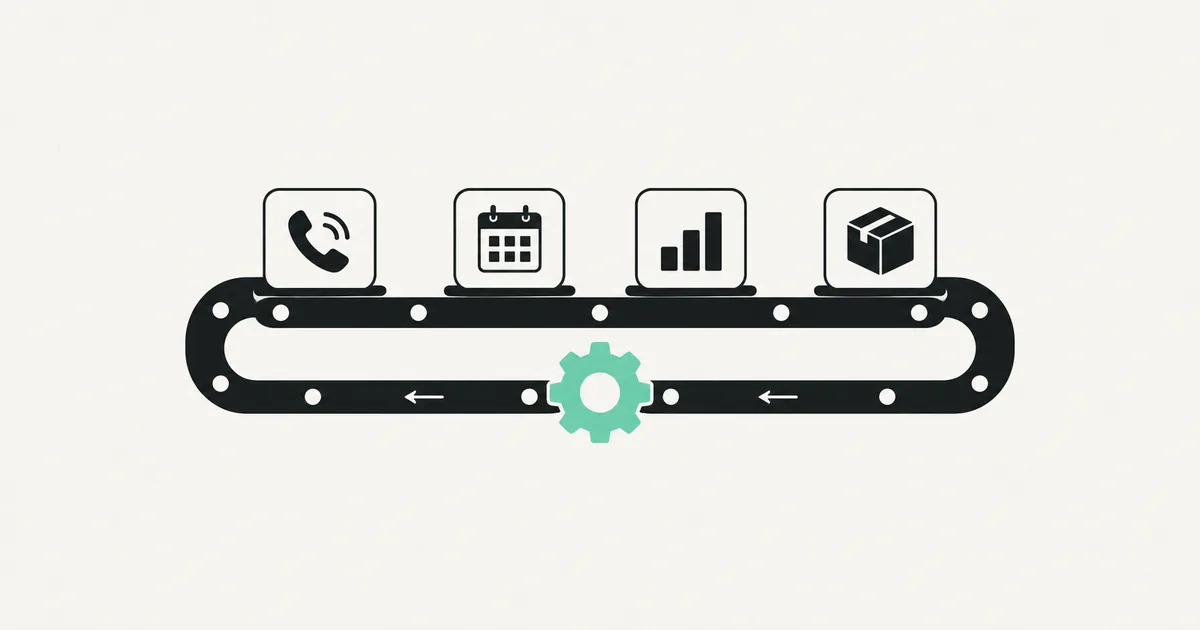
Most agencies do not have a lead problem. They have a follow-up problem. The leads come in from paid ads, referrals, and cold outreach, then sit in a form inbox while the founder is on a delivery call. By the time someone replies, the prospect has booked with a competitor who answered in ten minutes. Meanwhile your account managers spend half their week copying data between GoHighLevel, a spreadsheet, and a reporting doc.
This is exactly the kind of work AI automation deletes. Not the strategy, not the creative, not the client relationship — the mechanical glue between them. Below is the stack most agencies land on: Retell for voice, n8n for the logic, and GoHighLevel (GHL) as the CRM everything hangs off. Here is how the pieces fit and what to automate first.
Why this stack, specifically
You could build all of this a dozen ways. Agencies converge on these three because they map cleanly to the three jobs.
- GoHighLevel is where the agency world already lives — pipelines, calendars, SMS, email, and sub-accounts per client. It is the system of record.
- n8n is the automation engine. Self-hosted or cloud, no per-task pricing that punishes you at scale, and enough logic to handle branching, retries, and AI calls in one place. If you want the background on why we default to it, our primer on n8n covers it.
- Retell (or Vapi) is the voice layer — it answers and places calls with a natural AI agent that can book, qualify, and route.
The trap is buying a separate SaaS for every task. One automation layer wiring your existing tools together is cheaper to run and far easier to maintain than fifteen point solutions.

The four automations that pay for themselves
1. Speed-to-lead: reply in under 60 seconds
The single highest-ROI automation for any agency. A new lead hits your GHL form or Facebook lead ad. n8n catches the webhook, creates or updates the contact, and fires two things at once: an AI-drafted SMS/email that answers the obvious question and drops a booking link, and — for higher-ticket leads — a Retell voice agent that calls within a minute to qualify and book on the spot.
Speed-to-lead is not a marginal gain. Responding in the first minute versus the first hour routinely multiplies connect rates. For an agency running lead gen for clients, this is also a product you can resell.
2. AI voice qualification and booking
Retell answers inbound calls and places outbound ones. The agent follows a script you control: confirm the service, ask two or three qualifying questions, check the GHL calendar, and book. Everything it collects writes back to the contact record through n8n, so your team opens a lead that is already tagged, scored, and scheduled.
For appointment-heavy niches, this is the difference between a receptionist you pay for evenings and weekends and one that never sleeps. It pairs naturally with a proper booking flow — a sibling topic if you also run appointment automation for clients.
3. Reporting roll-ups that build themselves
Client reporting is where agency hours quietly vanish. n8n pulls the numbers on a schedule — ad spend, leads, booked calls, revenue — from the ad platforms and GHL, has an AI step write a plain-English summary of what changed and why, and drops a formatted report into a Google Doc or Slack channel per client. What took an account manager a full afternoon becomes a Monday-morning email nobody had to write.
4. Fulfillment and onboarding glue
New client signs. n8n spins up their GHL sub-account, clones your pipeline and calendar templates, sends the welcome sequence, creates the project folder, and posts a kickoff checklist to your team channel. Onboarding that used to eat two hours of coordination happens in seconds, the same way every time.
What each automation gives back
| Automation | What it replaces | Typical time saved | Reusable as a client offer? |
|---|---|---|---|
| Speed-to-lead reply | Manual first-touch on every lead | 5–8 hrs/week | Yes |
| Retell voice qualify + book | After-hours receptionist, manual dials | 6–10 hrs/week | Yes |
| Auto client reporting | Weekly report building by hand | 4–6 hrs/week | Yes |
| Onboarding automation | Manual sub-account and template setup | 2–3 hrs/client | Internal |
| Review + referral requests | Chasing happy clients manually | Higher review volume | Yes |
For a mid-size agency, that is comfortably 15–25 hours a week back across the team — and three of the five are things you can turn around and sell to your own clients.
A realistic build order
Do not try to automate everything in month one. A sane rollout:
- Instrument speed-to-lead first. It is the fastest win and the easiest to prove. Wire the webhook, the AI reply, and calendar booking. Measure connect rate before and after.
- Add Retell for the leads that deserve a call. Start outbound-only on a single campaign so you can listen to recordings and tune the script before it touches inbound.
- Automate one client's reporting end to end. Get the format right for one account, then template it across the roster.
- Then onboarding and the long tail. Once the revenue-facing pieces are solid, clean up the internal glue.
Keep a human in the loop while you build trust in each flow. Have the AI draft and a person approve until the output is reliably right, then let it run unattended. A half-finished automation your team does not trust is worse than none.
Where agencies get this wrong
Two failure modes. The first is fragile Zap sprawl — dozens of one-off automations nobody documented, breaking silently when an API changes. Consolidating into n8n with proper error handling and alerting fixes this. The second is letting the voice agent run before it is tuned. An AI that mishandles a hot lead is worse than voicemail. Test on outbound and low-stakes calls first, review transcripts, and tighten the prompt before it answers your main line.
Done right, this stack lets a lean agency carry more clients without proportionally more headcount — which is the whole point.
Frequently asked questions
Do I need to self-host n8n? Not necessarily. n8n Cloud works fine to start. Self-hosting saves money at scale and keeps client data on infrastructure you control, which matters if you handle regulated verticals.
Is Retell better than Vapi for agencies? Both are strong. Retell is often quicker to get a natural-sounding agent booking appointments; Vapi gives more low-level control. For most agency use cases the difference is small — pick one and go deep rather than hedging.
Can I resell these automations to my clients? Yes, and you should. Speed-to-lead, AI voice booking, and automated reporting are all sellable as recurring services. Many agencies find the internal build pays for itself and then becomes a new revenue line.
How long does it take to set up? A focused speed-to-lead build is days, not months. A full stack with voice, reporting, and onboarding is typically a few weeks depending on how many integrations and client sub-accounts are involved.
Want this running without gluing it together yourself? SprintX builds owned AI automation on Retell, n8n, and GoHighLevel — fixed-scope quote, and every workflow is yours to keep and resell. Tell us where your agency leaks hours and we will map the highest-value automations first.
AI agents and automation
AI agents that do the work.
We build agents and automations for the repetitive work your team does by hand, and measure what they save.
Keep reading.
More on ai agents and automation
AI agents and automation · 18 Jul 2026 · 9 min read
RPA vs AI Agents: Which Should Automate Your Back Office?
A decision guide to robotic process automation vs AI agents: what each is good at, where each breaks, costs, and how to pick the right tool for back-office work.
AI agents and automation · 18 Jul 2026 · 8 min read
Playwright MCP Server: AI Browser Automation That Actually Works
A plain-English guide to the Playwright MCP server: how AI agents control a real browser, why it beats pixel-guessing bots, and where it fits your business.

AI agents and automation · 18 Jul 2026 · 9 min read
The Best MCP Servers for Business in 2026 (Curated + Tested)
A curated shortlist of the most useful MCP servers for real businesses in 2026 — what each connects your AI agent to, where it shines, and what to watch out for.