SaaS Development Cost: A Realistic 2026 Budget Guide
A clear, founder-focused breakdown of what it costs to build and run a SaaS product in 2026 — from a lean MVP to a scaled multi-tenant platform.
 SprintX Team9 min read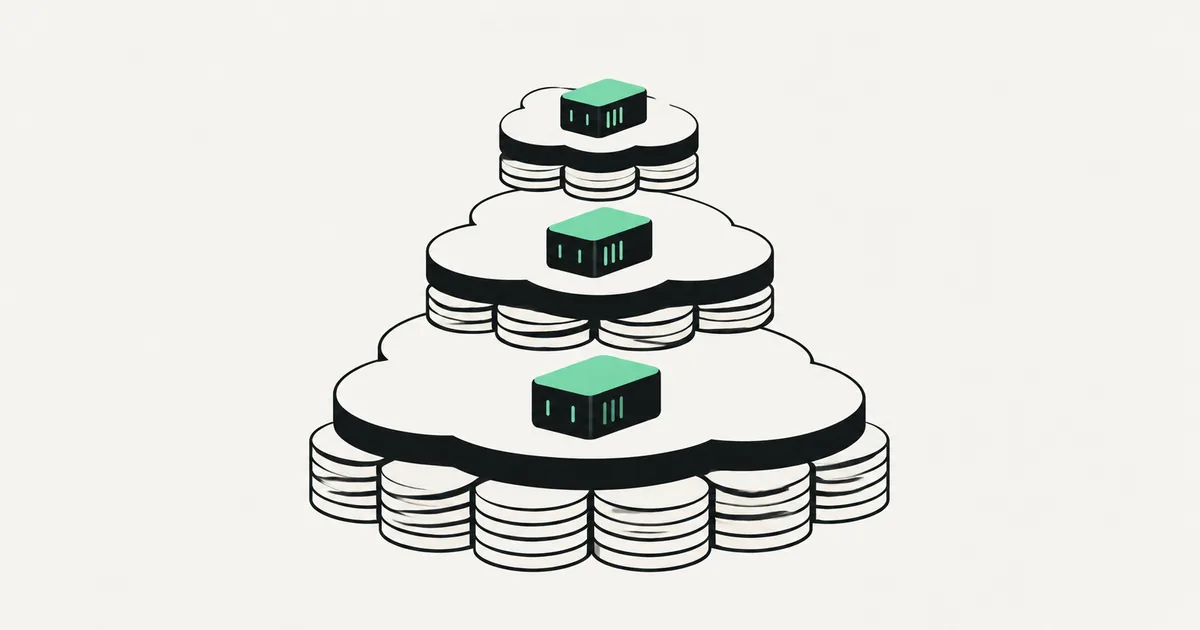
A SaaS product is never really "done." That single fact is why SaaS budgets confuse founders more than any other kind of software. You are not buying a deliverable — you are funding a product that starts small, earns its next feature, and runs every month it is alive. Budget for a one-time project and you will be blindsided within a quarter.
This guide gives you real 2026 numbers for both halves of the equation — what it costs to build your first version and what it costs to keep it running — plus the factors that decide where in the range you land.
The two budgets every SaaS needs
- Build budget (one-time-ish): designing and developing the product, in versions. The first version is the big one; each release after is smaller and demand-driven.
- Run budget (monthly): hosting, database, auth, email, payments, monitoring, and the AI or third-party APIs your product calls.
The run budget is the one founders underestimate. Even a modest SaaS with a few hundred users typically costs a few hundred dollars a month in infrastructure before any salaries — and it scales with usage, not with your feature list.
SaaS development cost by stage
Here is what each stage realistically costs in 2026 with a capable team on a modern stack (Next.js, Supabase or Postgres, Stripe, Vercel).
| Stage | Typical build cost | Monthly run cost |
|---|---|---|
| MVP (core workflow, single tenant) | $15,000 – $40,000 | $50 – $300 |
| Market-ready v1 (billing, roles, polish) | $40,000 – $90,000 | $200 – $800 |
| Scaling product (multi-tenant, integrations) | $90,000 – $200,000 | $800 – $3,000 |
| Mature platform (scale, SSO, compliance) | $200,000+ | $3,000+ |
An MVP proves that people will use — and ideally pay for — your core workflow. It is deliberately narrow. Read our take on building a SaaS MVP for how tight v1 should be.
A market-ready v1 adds the machinery paying customers expect: subscription billing, user roles, onboarding, and a level of polish that makes it feel trustworthy.
A scaling product serves many customers cleanly (multi-tenancy), connects to the tools they already use, and hardens for growing load.
A mature platform carries enterprise weight: single sign-on, audit logs, SOC 2 or HIPAA, and the architecture to handle serious scale.

What actually drives the price
- Multi-tenancy. Serving one customer is straightforward. Cleanly isolating hundreds of organizations' data — with per-tenant roles and settings — is core architecture that pays off later but costs upfront.
- Billing complexity. A single monthly plan via Stripe is quick. Tiers, usage-based metering, seats, trials, coupons, and proration each add real work.
- Roles and permissions. "Admin and member" is simple. Granular, per-resource permissions across teams is a substantial subsystem.
- Integrations. Every external system your customers expect — Slack, Google, HubSpot, QuickBooks, an AI model — is a mini-project with its own edge cases.
- Real-time and data volume. Live collaboration, dashboards over large datasets, and background processing raise the engineering bar.
- Compliance. SSO, audit trails, data residency, and certifications like SOC 2 or HIPAA add meaningful cost and time — but unlock bigger customers.
Move any of these and the quote moves with it. A good partner will pin them down before pricing, not after.
Why the run cost matters as much as the build
A SaaS you launch and forget will quietly bleed money and trust. The monthly line items add up: hosting and serverless functions, a managed Postgres database, authentication, transactional email, error monitoring, and — increasingly — AI API usage. That last one is where we see the ugliest surprises. An AI feature wired to call an expensive model on every keystroke can turn a $200/month infrastructure bill into $2,000 overnight.
Keeping run costs sane comes down to discipline: cache aggressively, route simple work to cheap models, run heavy jobs in the background, and only call paid APIs when a user actually needs the result. Built well, a healthy early-stage SaaS often runs for $200–$800/month in infrastructure, scaling smoothly as revenue grows rather than spiking ahead of it.
Build vs buy vs no-code
You have three paths, and the cheapest-looking one is often the most expensive over time.
- No-code builders get you to a demo fast and cost little upfront, but hit a wall on custom logic, scale, and data ownership. Many founders come to us to migrate off them after outgrowing the ceiling.
- Off-the-shelf platforms work if your idea fits their mold — but SaaS is usually a business precisely because it does something bespoke.
- Custom development costs more upfront and gives you a product you own, can scale, and can sell. For a real venture, it is almost always the right call past the prototype stage.
So what should you budget?
- Validate the idea (MVP): $15,000–$40,000 build, $50–$300/month run.
- Launch to paying customers (v1): $40,000–$90,000 build, $200–$800/month run.
- Scale to many customers: $90,000+ build, run cost scaling with usage.
Then plan for ongoing development — most healthy SaaS products reinvest a meaningful slice of revenue into product every month, because the roadmap never really ends.
Frequently asked questions
Can I build a SaaS for under $20,000? You can build a genuine MVP that proves your core workflow, yes. You cannot build a fully-featured, multi-tenant, billing-complete platform for that — and you should not try to. Prove demand first.
Why is the monthly cost so unpredictable? Because it scales with usage, especially AI and data. A product with ten users and one with ten thousand have very different bills. Architecture choices — caching, model routing, background jobs — decide whether that curve is gentle or brutal.
Is multi-tenancy worth the extra upfront cost? If you plan to serve many customers, yes — retrofitting tenant isolation later is far more expensive than building it in. If you are still validating, a simpler single-tenant MVP is fine.
How long until launch? A focused MVP is often 6–10 weeks. A market-ready v1 with billing and roles is typically 3–5 months.
Sizing a budget for your SaaS idea? SprintX builds SaaS products on Next.js and Supabase with a fixed-scope quote and no lock-in — you own the codebase and the roadmap. Tell us about your product and we'll give you a realistic number for v1 and beyond.
Building software
Systems your business runs on.
Custom platforms, internal tools and integrations that move work off spreadsheets.
Keep reading.
More on building software
Building software · 22 Jul 2026 · 8 min read
From MVP to Scale: What the Next Engineering Phase Costs
What the phase after a validated MVP costs — the four workstreams involved, realistic ranges, and the order that wastes the least money.
Building software · 18 Jul 2026 · 8 min read
SaaS MVP Cost in 2026: What a Real First Version Should Run
A founder-focused breakdown of what a SaaS MVP really costs in 2026 — by build approach, what drives the number, and how to spend the least to learn the most.
Building software · 11 Jul 2026 · 8 min read
How Much Does an MVP Cost to Build? (2026 Startup Guide)
A founder-focused guide to what a minimum viable product actually costs to build in 2026 — and how to keep the scope (and bill) under control.