What Is a RAG Chatbot? (And Why It Beats a Plain LLM)
A plain-English explanation of RAG chatbots — how retrieval-augmented generation works, why it stops hallucinations, and when your business needs one.
 SprintX Team8 min read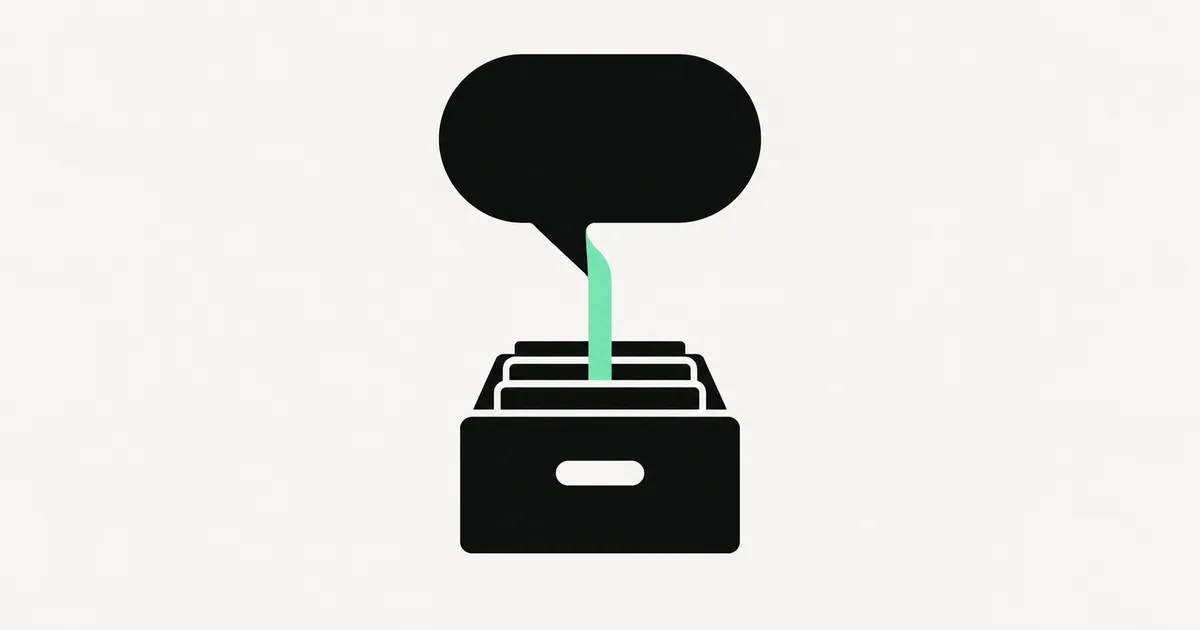
Ask a plain ChatGPT-style chatbot about your company's refund policy and it will confidently invent one. It has never read your policy — so it guesses, and it guesses in a fluent, authoritative voice that makes the wrong answer sound right. For a business, that is worse than no answer at all.
A RAG chatbot solves this. Instead of guessing from general training, it looks up the real answer in your documents first, then writes a reply grounded in what it found. This is the single most important upgrade for any business chatbot that needs to be correct, and it is worth understanding before you pay anyone to build one.
RAG in one sentence
RAG stands for Retrieval-Augmented Generation. The chatbot retrieves relevant passages from your knowledge base, then generates an answer using those passages as its source material. The LLM still writes the reply in natural language — but it writes from your facts, not its imagination.
Think of the difference between a student answering from memory versus one allowed to open the textbook before answering. Same student, dramatically better answers.
How a RAG chatbot works
Here is the flow, step by step, when a user asks a question:
- Ingestion (done once, up front). Your documents — PDFs, help articles, policies, product specs — get split into small chunks and converted into numeric "embeddings" that capture meaning. These are stored in a vector database.
- Retrieval. When a user asks something, the question is also turned into an embedding and matched against your stored chunks to find the most relevant passages.
- Augmentation. Those passages get inserted into the prompt sent to the LLM, along with the user's question.
- Generation. The LLM writes an answer grounded in the retrieved passages — and, if you set it up well, cites which document each fact came from.

The magic is in step 3. A plain LLM only has its frozen training data. A RAG chatbot gets fresh, private, business-specific context injected at the exact moment it answers.
RAG vs a plain LLM
| Plain LLM chatbot | RAG chatbot | |
|---|---|---|
| Knows your private docs | No | Yes |
| Stays current | Only to training cutoff | Update docs anytime |
| Hallucination risk | High on specifics | Much lower |
| Can cite sources | No | Yes |
| Setup effort | Low | Moderate |
A plain LLM is fine for brainstorming or generic writing. The moment accuracy on your facts matters — policies, pricing, product details, medical or legal guidance — RAG is the difference between a helpful assistant and a liability.
Why RAG beats fine-tuning for most businesses
People often assume the way to teach an AI about their business is to "train" or fine-tune a model on their data. For most use cases, that is the harder, more expensive path. Fine-tuning bakes knowledge into the model's weights — slow to update, costly, and it still hallucinates specifics. RAG keeps your knowledge in a database you can edit in seconds. Change a price, update the policy, add a new product doc, and the chatbot is instantly current with no retraining. For a deeper comparison, our guide on fine-tuning vs RAG walks through when each one actually makes sense.
What you need to build one
A production RAG chatbot has a few moving parts:
- A vector database — Supabase (with pgvector), Pinecone, or Weaviate to store and search embeddings.
- An embedding model — to turn text into searchable vectors.
- An LLM — GPT, Claude, or an open model to generate the final answer.
- A retrieval pipeline — the glue that chunks documents, ranks results, and assembles the prompt.
- Guardrails — so the bot says "I don't know" instead of guessing when retrieval comes back empty.
That last point matters more than people expect. A good RAG chatbot knows the boundary of its knowledge. When nothing relevant is retrieved, it should admit it rather than fall back to inventing an answer — that discipline is what makes it trustworthy for a legal, medical, or financial setting.
Where RAG chatbots shine
- Customer support that answers from your actual help docs and cites the article.
- Internal knowledge assistants so staff stop pinging each other for the same policy questions.
- Sales enablement bots that pull accurate product specs and pricing on demand.
- Regulated industries — legal, healthcare, finance — where every answer must trace back to a real source.
Frequently asked questions
Is a RAG chatbot the same as a custom GPT? They overlap. A custom GPT with uploaded files uses a light form of retrieval. A purpose-built RAG chatbot gives you control over the vector database, chunking, ranking, and citations — which matters when accuracy and volume are high.
How much does a RAG chatbot cost? Most business RAG builds land in the $3,000–$8,000 range to build, plus $100–$500/month to run depending on volume. The cost is driven by how much knowledge it covers and how strict the accuracy bar is.
Will it ever hallucinate? Risk drops sharply but never hits zero. Good retrieval, source citations, and an honest "I don't know" fallback keep it well within the range businesses can trust.
How do I keep it up to date? You update the documents. Re-ingest the changed files and the chatbot answers from the new version — no model retraining needed.
Need a chatbot that answers from your real documents instead of guessing? SprintX builds custom RAG chatbots on Supabase and modern LLMs — grounded, source-cited, and delivered on a fixed-scope quote you own. Talk to us about what yours would take.
AI agents and automation
AI agents that do the work.
We build agents and automations for the repetitive work your team does by hand, and measure what they save.
Keep reading.
More on ai agents and automation
AI agents and automation · 11 Jul 2026 · 8 min read
Fine-Tuning vs RAG: Which Does Your AI Project Need?
A clear, non-hype comparison of fine-tuning and RAG so you can pick the right approach for your AI project the first time.
AI agents and automation · 18 Jul 2026 · 9 min read
7 Intercom Alternatives in 2026 (And When a Custom Bot Wins)
A no-hype look at seven Intercom alternatives in 2026, what each is good for, and the point where a custom-built support bot becomes the smarter buy.
AI agents and automation · 18 Jul 2026 · 8 min read
Ecommerce Chatbot: Boosting Sales and Cutting Support Tickets
A practical look at how an ecommerce chatbot lifts sales and cuts support load, with real workflows, cost ranges, and a buyer-focused build plan.