AI Chatbot: Build Custom vs Buy Off-the-Shelf
Should you build a custom AI chatbot or buy an off-the-shelf one? A balanced breakdown of cost, control, data ownership, and the point where custom wins.
 SprintX Team8 min read
Every business that wants an AI chatbot faces the same decision early: sign up for an off-the-shelf tool that promises a working bot in an afternoon, or have one built around your actual product and data. The marketing for the off-the-shelf option is loud and the number is small, so it usually wins by default. Sometimes that's the right call. Often it's the start of a slow frustration that ends with a rebuild.
Here's an honest look at both paths, what each really costs, and the specific signals that tell you which one fits.
What "buy" and "build" actually mean
Buying off-the-shelf means a subscription chatbot platform. You paste in your website or help docs, tweak some settings, drop a widget on your site, and you have a bot answering questions. Setup is fast and the monthly fee is predictable.
Building custom means a chatbot developed for your business — your data, your integrations, your tone, your logic — usually with a retrieval system (RAG) so it answers from your real content, and connections into the tools where your answers actually live. It costs more upfront and takes longer, but it fits.
The honest truth: for a simple FAQ bot, off-the-shelf is often the smart, cheap answer. The build case gets stronger the moment the bot needs to do something, not just answer something.
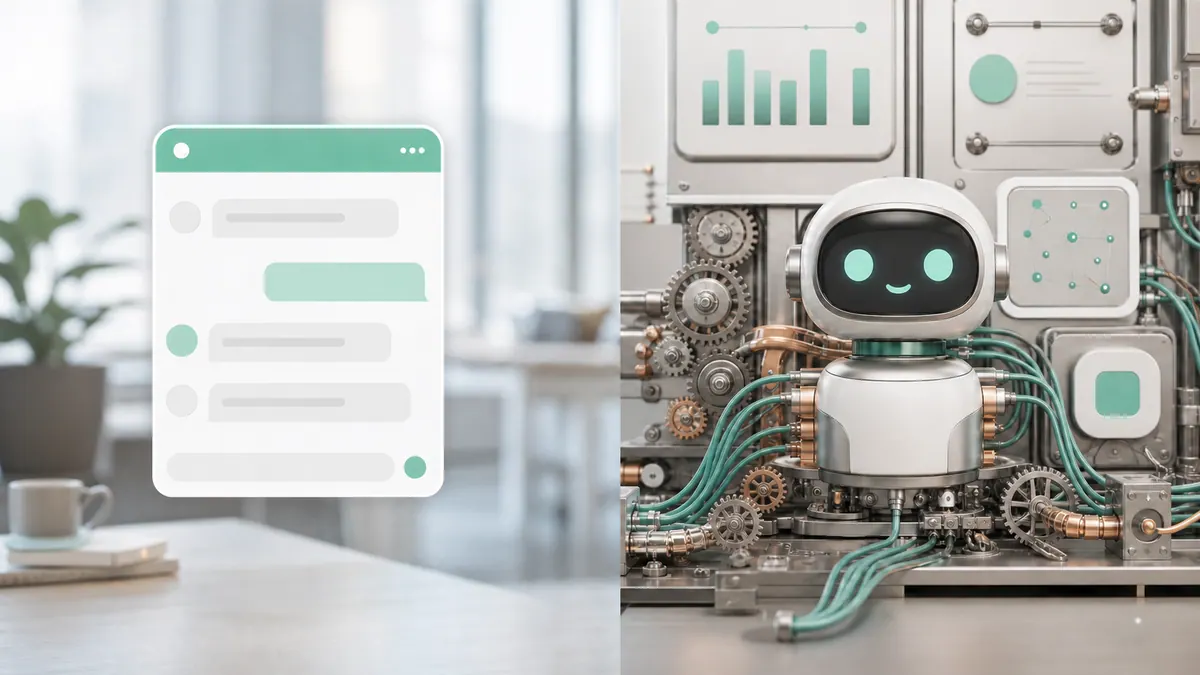
The comparison
| Buy (off-the-shelf) | Build (custom) | |
|---|---|---|
| Upfront cost | Low (often $0 setup) | $3,000 – $25,000+ |
| Monthly cost | $50 – $500+ | Hosting + model usage |
| Time to live | Hours to days | 2 – 6 weeks |
| Fits your workflow | Within their limits | Exactly |
| Data ownership | On their platform | Yours |
| Deep integrations | Limited | Full |
| Lock-in risk | High | Low |
| Best for | Simple FAQ, fast start | Complex logic, real actions |
Where off-the-shelf genuinely wins
Don't over-engineer. If you need a bot that answers common questions from your existing help content, deflects easy support tickets, and points people to the right page, an off-the-shelf tool is fast, cheap, and perfectly good. You'll be live this week. For a lot of small businesses, that's the entire requirement, and paying for a custom build would be waste.
Off-the-shelf also wins when you want to test demand. Standing up a cheap bot to see whether customers actually use it is a sensible experiment before investing in anything bespoke.
Where custom pulls ahead
The subscription bot hits a ceiling the moment your needs get specific. Custom becomes the better buy when:
- The bot needs to take actions, not just talk — check an order, book an appointment, look up an account, create a ticket, update a CRM. Off-the-shelf tools integrate shallowly; a custom bot wires directly into your systems.
- Answers must come from your private data, accurately and with sources. A well-built RAG chatbot retrieves from your real documents and cites them, which matters enormously in legal, medical, or financial contexts where a confident wrong answer is a liability.
- Volume makes per-conversation pricing painful. Off-the-shelf plans that look cheap at 500 chats a month can sting at 50,000. A custom bot on usage-based model pricing often costs less at scale.
- The experience has to match your brand and product — tone, flow, edge cases, escalation rules — beyond what a settings page allows.
- Data ownership and privacy are non-negotiable. With custom, the conversations and the knowledge base live on infrastructure you control, not a vendor's.
The recurring theme: buy when the bot answers, build when the bot works.
The hidden costs on both sides
Neither option is free of surprises. Off-the-shelf tools carry lock-in — your knowledge base, tuning, and conversation history live on their platform, and leaving means starting over. Prices also creep as you add seats, volume, or features that were gated behind a higher tier.
Custom builds carry running costs — hosting and AI model usage — that you have to design for. An AI chatbot that fires an expensive model on every message can quietly cost more than it should. Good engineering (caching, routing simple questions to cheaper models, retrieval that keeps prompts small) keeps that flat. It's the same discipline that keeps any production AI system affordable.
A simple way to decide
Answer three questions honestly:
- Does the bot need to do more than answer questions? If yes, lean build. If it's pure FAQ, buy is fine.
- How sensitive is your data, and how bad is a wrong answer? High stakes push toward a custom, source-citing build.
- What's your real conversation volume? Low volume favors a cheap subscription; high volume often favors custom economics.
A pragmatic path many businesses take: start with an off-the-shelf bot to learn what customers actually ask, then commission a custom build once you know the real requirements — and once the off-the-shelf ceiling is in sight.
Frequently asked questions
Isn't building a chatbot way more expensive? Upfront, yes. Over time, not always. Off-the-shelf subscriptions and their per-conversation costs add up, and at volume a custom bot on usage-based pricing can be cheaper to run. The bigger difference is capability — custom does things off-the-shelf simply can't.
Can I start with off-the-shelf and move to custom later? Absolutely, and it's often the smart sequence. The off-the-shelf phase teaches you exactly what real users ask, which makes the eventual custom build sharper and cheaper to scope. The main cost is that tuning and history usually don't transfer.
What makes a custom chatbot worth it? Real integrations (it can act on your systems), accurate answers from your private data with sources, brand-perfect experience, data ownership, and better economics at scale. If none of those matter to you, off-the-shelf is the right, frugal choice.
How long does a custom chatbot take to build? A focused custom bot — RAG over your content plus a couple of integrations — is usually two to six weeks. Complexity comes from the integrations and edge cases, not the chat itself.
Build versus buy isn't ideology — it's matching the tool to what the bot actually needs to do. SprintX builds custom AI chatbots that answer from your real data and act on your real systems, on a fixed-scope quote with no lock-in and the result owned by you. Tell us what you want the bot to handle and we'll tell you honestly whether to build or just buy.
Cost, hiring and outsourcing
Start with a project, keep us on, or let us look after it.
Three ways to work with us, and how the first weeks run.
Keep reading.
More on cost, hiring and outsourcing
Cost, hiring and outsourcing · 18 Jul 2026 · 8 min read
FlutterFlow vs Bubble: Which No-Code App Builder Should You Pick?
A practical FlutterFlow vs Bubble comparison for founders deciding between a native mobile builder and a web app builder, with honest trade-offs.
Cost, hiring and outsourcing · 18 Jul 2026 · 8 min read
Zendesk Alternatives in 2026: Cheaper Support Stacks Compared
A 2026 comparison of Zendesk alternatives and cheaper support stacks — from lean help desks to AI-first tools to custom builds.
Cost, hiring and outsourcing · 18 Jul 2026 · 8 min read
Synthflow vs Vapi vs Retell: Choosing a Voice AI Platform in 2026
A hype-free 2026 comparison of Synthflow, Vapi, and Retell — no-code ease versus developer control — and how to pick the right voice AI platform.