ChatGPT vs Claude for Business Automation: Which to Use
A practical comparison of ChatGPT and Claude for real business automation work — not benchmarks, but which model to reach for on which job.
 SprintX Team8 min read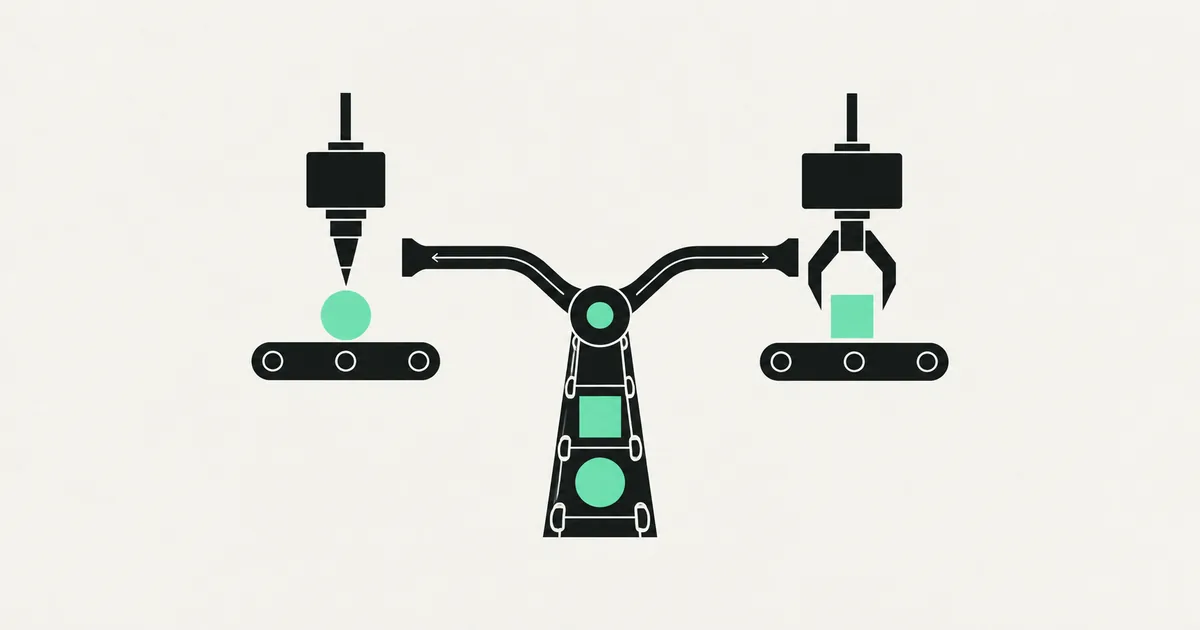
"Should we standardize on ChatGPT or Claude?" is the wrong question, and it's costing businesses money. The teams getting real value from AI don't pick one model and marry it. They pick the right model for each job — and quietly route work between them behind the scenes.
Still, you have to start somewhere, and the two families from OpenAI (ChatGPT / GPT models) and Anthropic (Claude) genuinely differ in ways that matter for automation. This guide skips the leaderboard benchmarks and talks about what actually shows up when you put these models to work inside a business.
First, separate the app from the API
A lot of confusion comes from mixing two different things:
- The chat apps (ChatGPT and Claude's web/desktop apps) — what your team uses by hand for drafting, research, and brainstorming.
- The APIs — what powers automation: a model reading every incoming email, summarizing documents, classifying tickets, or drafting replies without a human clicking anything.
For day-to-day staff use, the honest answer is that both chat apps are excellent and the choice is close to a coin flip. The interesting decision is at the API level, where you're building a workflow that calls a model thousands of times a month. That's where cost, reliability, and each model's strengths start to add up. Under the hood this is closely related to prompt engineering — the same model gives very different results depending on how it's instructed.
Where each model tends to shine
Neither model is universally "better." After building automations on both, here's the pattern we see.
Claude tends to lead on:
- Long documents — reading and reasoning over lengthy contracts, transcripts, or knowledge bases in a single pass.
- Careful, natural writing that needs less editing.
- Following complex, multi-step instructions without cutting corners.
- Coding tasks and structured output that has to be reliable.
ChatGPT / GPT tends to lead on:
- The broadest ecosystem — plugins, tools, and integrations built around it.
- Image generation and multimodal features bundled together.
- Voice interactions in the consumer app.
- Massive third-party support, so most no-code tools connect to it first.

ChatGPT vs Claude for business automation
| Factor | ChatGPT (OpenAI) | Claude (Anthropic) |
|---|---|---|
| Long documents | Strong | Often stronger |
| Natural writing | Very good | Excellent, less editing |
| Coding / structured output | Very good | Excellent |
| Ecosystem & integrations | Broadest | Growing fast |
| Multimodal (images, voice) | More built-in | More text-focused |
| Best default for | General-purpose, integrations | Documents, reliability, code |
The cost reality for automation
At the API level, both providers offer a range of models — small and cheap up to large and capable — and this is where automation budgets are won or lost. The mistake we clean up most often is a business piping every task through the biggest, most expensive model when 80% of the work could run on a small one.
A smart automation routes by difficulty: a tiny, cheap model handles the easy classification and extraction, and only genuinely hard cases escalate to a flagship model. Done well, this cuts model spend by more than half without a noticeable drop in quality. The provider matters far less than this routing discipline — and it's exactly the kind of thing an off-the-shelf tool won't do for you.
So which should you choose?
- If you're picking one for the whole company to use by hand: either is fine. Choose on interface preference and price. Many teams keep both.
- If you're automating document-heavy work — contracts, reports, long transcripts, knowledge bases — Claude is a strong default.
- If you need the widest integrations and multimodal features in one place, ChatGPT is the safer default.
- If you're building a real automation that runs at volume, don't marry either. Build so the model is swappable, route easy work to cheap models, and reserve the flagship for hard cases.
The businesses that win with AI treat models like interchangeable parts, not a religion. The value isn't in the model — it's in the workflow you wrap around it. If you'd rather not commit to a single vendor, the answer is to build the automation so the model stays swappable from day one.
Frequently asked questions
Is Claude better than ChatGPT? Neither is universally better. Claude often edges ahead on long documents, careful writing, and reliable code; ChatGPT leads on ecosystem breadth and built-in multimodal features. For automation, match the model to the task rather than crowning a winner.
Can I use both in one automation? Yes, and serious builds often do. You can route each step to whichever model handles it best, or fail over to the other if one provider has an outage. Designing the system so the model is swappable is the smart move.
Which is cheaper for business use? Both offer cheap small models and pricey flagship ones, so the provider matters less than which model you call and how often. The biggest savings come from routing simple tasks to a small model instead of running everything through a flagship.
Do I need a developer to automate with these? For a simple, one-off task inside the chat app, no. For a reliable workflow that reads real business data at volume — with error handling, cost controls, and model routing — yes, and that's where a build partner pays for itself.
Trying to figure out where AI actually fits in your operations? SprintX builds business automations on ChatGPT, Claude, or both — with cost controls and swappable models so you're never locked to one vendor. Get a fixed-scope quote and you own the result.
AI agents and automation
AI agents that do the work.
We build agents and automations for the repetitive work your team does by hand, and measure what they save.
Keep reading.
More on ai agents and automation
AI agents and automation · 18 Jul 2026 · 9 min read
Zapier Alternatives in 2026: n8n, Make and When to Go Custom
A practical guide to Zapier alternatives in 2026: how n8n, Make, and others compare, and the point where a custom-built automation beats any SaaS tool.
AI agents and automation · 11 Jul 2026 · 10 min read
n8n vs Make: Which Automation Platform Fits Your Workflow?
A practical n8n vs Make comparison built around simple and branching workflows, with honest trade-offs on credits, executions, hosting, and maintenance.

AI agents and automation · 27 Jul 2026 · 6 min read
Cursor vs Claude Code for Building Something You Ship
Both work on your real repo, which puts them ahead of every builder. The difference is how much you see, how much you review, and what the codebase looks like in month three.