Fine-Tuning vs RAG: Which Does Your AI Project Need?
A clear, non-hype comparison of fine-tuning and RAG so you can pick the right approach for your AI project the first time.
 SprintX Team8 min read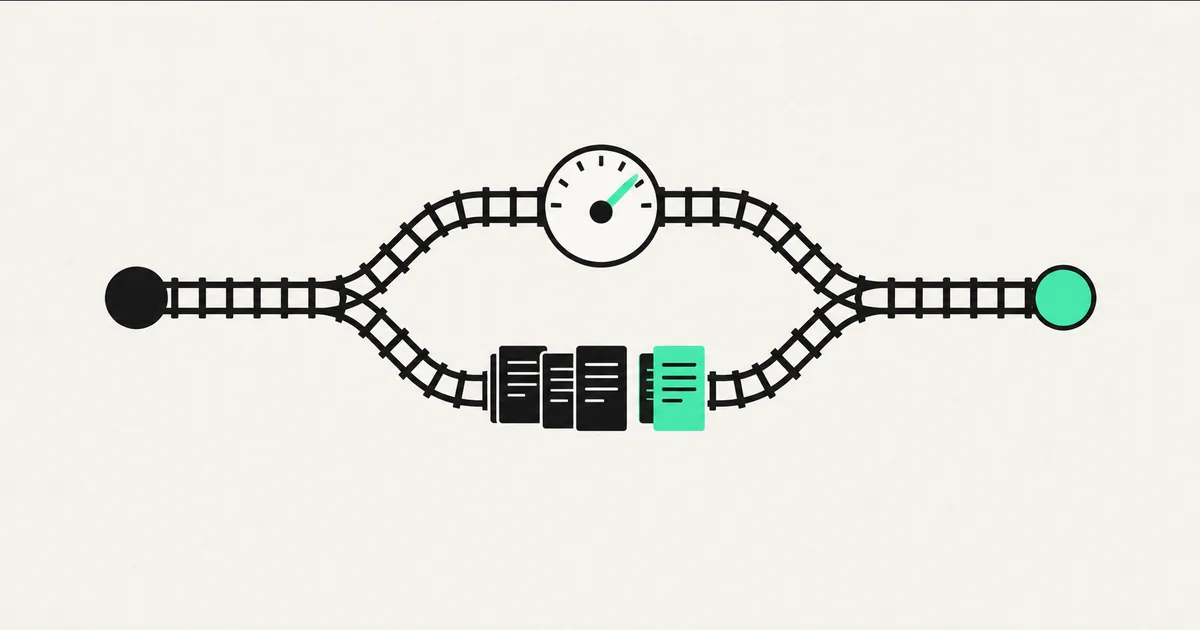
"Should we fine-tune a model on our data?" is one of the most common questions we hear from founders starting an AI project — and about 80% of the time, the honest answer is "no, you want RAG instead." The two get talked about as if they compete, but they solve different problems. Confuse them and you can burn tens of thousands of dollars teaching a model something it will forget the moment your data changes.
Here is the plain-English version of what each one actually does, what it costs, and how to pick the right one before you write a single line of code.
The one-line difference
RAG (retrieval-augmented generation) gives the model a library card. When someone asks a question, the system looks up the relevant documents from your own content and hands them to the model along with the question. The model reads them and answers. Its knowledge lives in a searchable database you control.
Fine-tuning sends the model to school. You take a base model and keep training it on thousands of your own examples until the behavior itself changes — its tone, its format, the way it reasons about a narrow task. The knowledge is baked into the model's weights.
So RAG changes what the model knows. Fine-tuning changes how the model behaves. That distinction decides almost every real project.

When RAG is the right call
Reach for RAG when the problem is knowledge. If you want a system that answers questions about your product docs, policies, contracts, past tickets, or a body of research, RAG is almost always the answer. A few reasons it wins for most business use cases:
- Your data changes. Update a document, re-index it, and the assistant knows the new answer in minutes. No retraining.
- You need citations. Because the model is reading real source passages, it can quote and link them. That is essential for legal, medical, finance, and support use cases where a wrong-but-confident answer is dangerous.
- It is cheaper to start. A production RAG chatbot is a build project, not a research project. You are wiring together a vector database, an embedding step, and a good prompt.
- It reduces hallucination. Grounding answers in retrieved text is the single most effective way to stop a model from inventing facts.
Most of what people call a "custom AI" — a support bot trained on your help center, an internal assistant over your wiki, a legal tool that cites real clauses — is really a RAG system. The retrieval layer usually leans on a vector database to find the right passages fast.
When fine-tuning earns its keep
Fine-tuning is the right tool when the problem is behavior, not knowledge. Good candidates:
- A consistent format or style the base model cannot reliably hold — turning messy notes into a strict JSON schema, or matching a very specific brand voice across thousands of outputs.
- A narrow, repetitive classification task where you have thousands of labeled examples and need speed and low cost per call.
- Compressing a long prompt. If every request needs a giant instruction block, fine-tuning can bake those instructions in, shrinking each call and cutting token costs at high volume.
Notice what is missing from that list: "teaching the model new facts." Fine-tuning is a poor and expensive way to add knowledge. The model may memorize some of it, but it will also blur details, and the moment a fact changes you are retraining again. For facts, use RAG.
The comparison at a glance
| Factor | RAG | Fine-Tuning |
|---|---|---|
| Best for | Knowledge, Q&A, citations | Behavior, tone, strict format |
| Handles changing data | Yes — re-index in minutes | No — requires retraining |
| Can cite sources | Yes | No |
| Typical setup cost | $3,000–$20,000 build | $10,000–$50,000+ project |
| Ongoing cost | Vector DB + API calls | Retraining when data drifts |
| Hallucination risk | Lower (grounded) | Unchanged or higher |
| Time to first version | Days to weeks | Weeks to months |
| Data needed | Your documents | Thousands of clean examples |
The cost ranges are directional, but the shape holds: RAG is faster and cheaper to stand up, fine-tuning is a heavier commitment that pays off only for the specific behavior problems above.
You can use both
The framing as a versus is a bit of a trap. Mature systems often combine them: fine-tune a model so it reliably outputs the exact format and tone you want, then use RAG to feed it fresh, cited knowledge at query time. The fine-tune handles how it speaks; retrieval handles what it knows right now.
But — and this matters — you almost never start there. Build the RAG system first. Ship it. Only once it is in real use and you can see a specific, repeated behavior problem that prompting cannot fix should you consider adding a fine-tune on top. Starting with fine-tuning is how projects stall for three months before anyone sees a working demo.
How to decide in five minutes
Ask these in order:
- Is the goal to answer questions from a body of content? If yes, start with RAG. Stop here.
- Do the answers need to cite sources or stay current? If yes, RAG — fine-tuning cannot do either well.
- Is the real problem a stubborn format or tone issue that survives careful prompting? Only then does fine-tuning enter the picture.
- Do you have thousands of clean, labeled examples? No examples, no fine-tune. This is the step that quietly kills most fine-tuning plans.
- Would a better prompt or a bigger base model solve it? Try that first. It is free and takes an afternoon.
If you cannot get past step one with a clear "we need behavior change, not knowledge," you want RAG.
Frequently asked questions
Is RAG cheaper than fine-tuning? To start, yes — clearly. RAG is a build project with predictable cost. Fine-tuning adds data preparation, training runs, and evaluation, and you repeat that work whenever your data drifts. At very high call volume a fine-tune can lower per-request cost, but that is an optimization, not a starting point.
Can fine-tuning teach a model my company's facts? Poorly. It may memorize some, but it blurs details and goes stale the instant a fact changes. For facts, use RAG so you can update a document instead of retraining a model.
Do I need a data scientist for either one? For RAG, no — it is an engineering build (vector database, embeddings, prompt design, guardrails). Fine-tuning benefits from someone who understands training data curation and evaluation, which is part of why it costs more.
What if I am not sure which I need? Default to RAG and ship something small. It is faster, cheaper, and reversible. You will learn far more from a working v1 in real hands than from months of planning a fine-tune.
Not sure whether your AI project needs RAG, a fine-tune, or just a sharper prompt? SprintX builds production AI systems the pragmatic way — RAG-first, with fine-tuning only where it truly pays off. Get a fixed-scope quote, keep full ownership of the result, and tell us what you are trying to build so we can point you at the cheapest path that actually works.
AI agents and automation
AI agents that do the work.
We build agents and automations for the repetitive work your team does by hand, and measure what they save.
Keep reading.
More on ai agents and automation
AI agents and automation · 11 Jul 2026 · 8 min read
What Is a RAG Chatbot? (And Why It Beats a Plain LLM)
A plain-English explanation of RAG chatbots — how retrieval-augmented generation works, why it stops hallucinations, and when your business needs one.
AI agents and automation · 18 Jul 2026 · 9 min read
7 Intercom Alternatives in 2026 (And When a Custom Bot Wins)
A no-hype look at seven Intercom alternatives in 2026, what each is good for, and the point where a custom-built support bot becomes the smarter buy.
AI agents and automation · 18 Jul 2026 · 8 min read
Ecommerce Chatbot: Boosting Sales and Cutting Support Tickets
A practical look at how an ecommerce chatbot lifts sales and cuts support load, with real workflows, cost ranges, and a buyer-focused build plan.