Building a Legal AI Chatbot That Only Cites Real Sources
How to build a legal AI chatbot that grounds every answer in real sources, refuses to hallucinate case law, and stays inside safe guardrails.
 SprintX Team9 min read
In 2023 a pair of lawyers submitted a brief that cited six court decisions. The cases did not exist. ChatGPT had invented them — names, citations, quotes, all fabricated — and the lawyers had trusted the output without checking. The court sanctioned them, and the story became the cautionary tale every legal professional now knows. It is the single biggest reason firms are nervous about AI, and it is exactly the failure a well-built legal AI chatbot is designed to make impossible.
The lesson is not "AI cannot be trusted in law." It is that a general chatbot answering from memory will confidently make things up, and in law a made-up citation is a career risk. The fix is an architecture where the bot cannot answer from memory at all — it can only answer from real sources it retrieves, and it must show its work. This is how you build that.
Why plain chatbots hallucinate case law
A standard large language model does not look anything up. It predicts plausible text based on patterns in its training data. Ask it for a case supporting an argument and it produces something that looks exactly like a real citation — correct format, plausible court, convincing quote — because it has seen thousands of real ones. It has no mechanism to check whether the case exists. That is not a bug you can prompt away; it is how the base model works.
For most uses a wrong answer is annoying. In law it is catastrophic. A fabricated citation in a filing, a misstated statute in client advice, an invented clause in a contract summary — each is a real liability. So a legal chatbot cannot be a plain model with a legal-sounding prompt. It has to be built so that hallucinated law is architecturally blocked, not just discouraged.
The core fix: retrieval-augmented generation
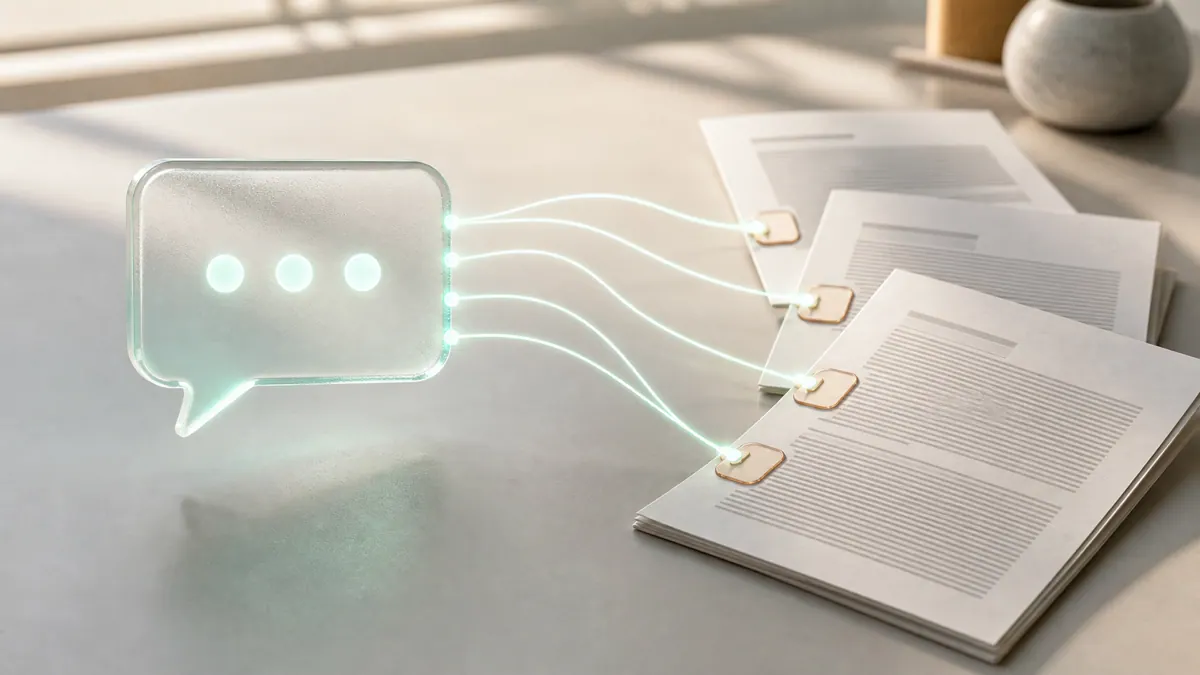
The foundation is RAG — retrieval-augmented generation. Instead of asking the model what it knows, you first retrieve the relevant passages from a trusted corpus — your firm's documents, a licensed case-law database, statutes, your contract library — and then instruct the model to answer only from those retrieved passages, quoting and citing them.
The flow looks like this:
- Ingest a trusted corpus — statutes, case law from a licensed source, firm precedents, and internal memos, chunked and embedded into a vector database.
- Retrieve on every question — the user's query pulls the most relevant real passages.
- Answer only from what was retrieved — the model is instructed to use nothing else, and to cite the source of each claim.
- Refuse when there is nothing — if retrieval returns no relevant source, the bot says it cannot find support rather than inventing one.
That last step is the whole game. A legal bot's most important skill is saying "I don't have a source for that." If you want the conceptual background, our explainer on what a RAG chatbot is and our primer on vector databases cover the machinery underneath.
Guardrails that make it safe for legal work
RAG is necessary but not sufficient. A production legal chatbot layers several guardrails on top:
| Guardrail | What it does |
|---|---|
| Citation enforcement | Every factual claim must link to a retrieved source, or it is withheld |
| Refusal on empty retrieval | No source found means no answer, not a guess |
| Confidence thresholds | Weak matches trigger a hand-off to a human, not a confident reply |
| Scope limits | Stays inside its practice area and refuses out-of-scope legal questions |
| Human-in-the-loop | Drafts and research are reviewed by a lawyer before they are used or filed |
| Audit trail | Every answer logs the sources it used, for later verification |
The combination matters. Citation enforcement means a user can click through and verify every claim against the real document. Refusal on empty retrieval means the bot fails safe. The audit trail means nothing is a black box. Together they turn "AI you cannot trust" into "AI that shows its work on every answer."
What a legal AI chatbot is good for
Set up this way, a legal chatbot is genuinely useful across a firm's day-to-day work:
- Document Q&A — ask questions across a case file or contract set and get answers with pinpoint citations to the source pages.
- Legal research assistance — surface relevant real cases and statutes from a licensed corpus, with links, to speed up a lawyer's own research.
- Contract review — flag clauses, summarize terms, and compare against a standard, always pointing to the actual language.
- Client intake — answer common client questions from approved firm content and route the rest to a human.
- Internal knowledge — let associates query the firm's own precedent library instead of emailing around for "that memo from last year."
The framing that keeps it safe: the bot is a research and drafting assistant that always shows its sources, never an oracle that gives final legal advice. A lawyer stays in the loop on anything that matters.
What it costs and how it is built
A legal chatbot is a custom build, not an off-the-shelf widget, because the corpus and guardrails are the entire point. Rough 2026 figures:
| Item | Typical range |
|---|---|
| Custom RAG build (ingestion, retrieval, guardrails, UI) | $10,000 – $40,000+ |
| Licensed case-law data | Varies by provider |
| Model/API usage | $100 – $1,000+ / month |
| Ongoing maintenance and corpus updates | Monthly retainer |
It costs more than a generic support bot because the accuracy bar is absolute and the guardrails are non-negotiable. For a firm, the comparison is not against a cheap chatbot — it is against billable hours saved and the risk of a single sanctioned filing avoided. You can see how we scope grounded, cited AI systems on SprintX; the engineering is in the retrieval quality and the refusal behavior, not the chat window.
Frequently asked questions
Can it guarantee it never hallucinates? No system is perfect, but a proper RAG build with citation enforcement and refusal-on-empty-retrieval makes fabricated law extremely unlikely — and every answer is verifiable against its cited source, so a reviewer can catch anything that slips.
Does it replace a lawyer's judgment? No, and it should not be built to. It is a research and drafting assistant that surfaces real, cited sources faster. A lawyer reviews and owns anything that goes to a client or a court.
Where does the case law come from? From a trusted, licensed source you provide, plus your firm's own documents. The bot only answers from that corpus — it never reaches into the open model's memory for legal facts.
Is client data kept private? It can be. The system can run on infrastructure you control, with your documents kept private and access restricted, so confidential material never leaves your environment.
A legal AI chatbot is only worth having if it never invents a case. SprintX builds grounded legal AI systems on RAG with citation enforcement, refusal guardrails, and full audit trails — so every answer traces to a real source. Fixed-scope quote, and it is yours to keep. Get in touch and we will map a build that stands up to scrutiny.
AI agents and automation
AI agents that do the work.
We build agents and automations for the repetitive work your team does by hand, and measure what they save.
Keep reading.
More on ai agents and automation
AI agents and automation · 18 Jul 2026 · 9 min read
7 Intercom Alternatives in 2026 (And When a Custom Bot Wins)
A no-hype look at seven Intercom alternatives in 2026, what each is good for, and the point where a custom-built support bot becomes the smarter buy.
AI agents and automation · 18 Jul 2026 · 8 min read
Ecommerce Chatbot: Boosting Sales and Cutting Support Tickets
A practical look at how an ecommerce chatbot lifts sales and cuts support load, with real workflows, cost ranges, and a buyer-focused build plan.
AI agents and automation · 18 Jul 2026 · 9 min read
Chatbot Development Cost in 2026: RAG, Voice and Beyond
A practical, no-hype guide to chatbot development cost in 2026 — build ranges, running costs, and what pushes a RAG or voice bot up or down in price.