What Is a Vector Database? (RAG's Secret Ingredient)
The non-technical explanation of vector databases: what they are, why RAG chatbots need them, and how to choose one.
 SprintX Team8 min read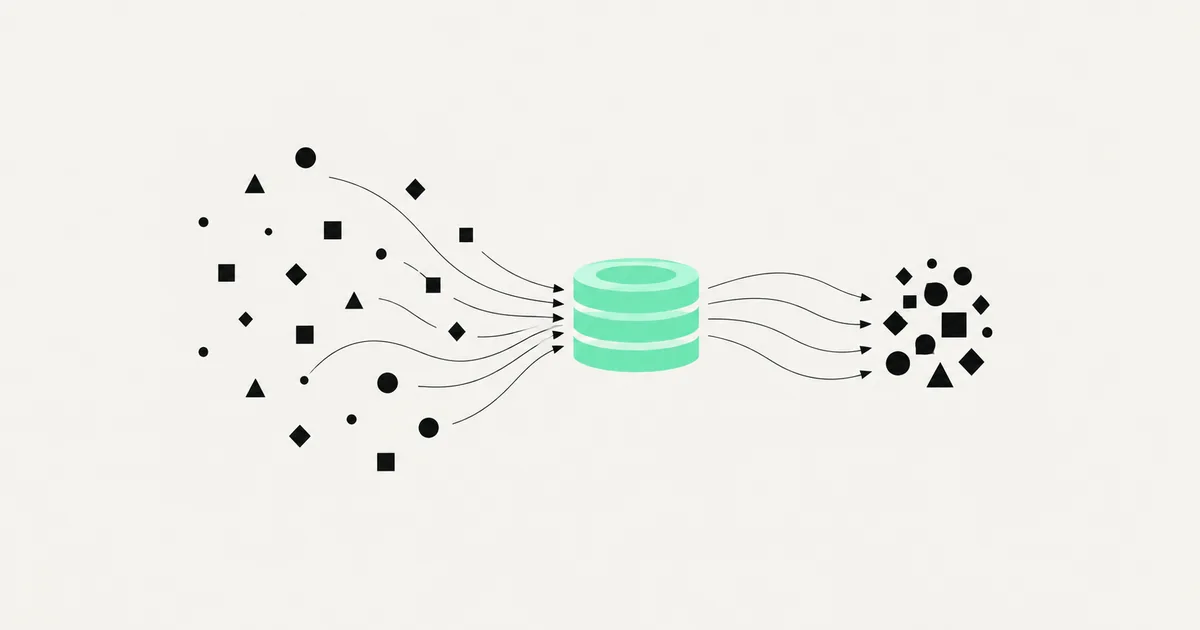
Every time you hear that a chatbot was "trained on your documents," there is usually a quieter piece of technology doing the real work behind the scenes: a vector database. It is the part that lets an AI assistant find the three most relevant paragraphs out of ten thousand pages in a fraction of a second, so the model can answer using your actual content instead of making something up. Understand this one component and most of how modern AI apps work suddenly clicks.
You do not need a math degree for this. Here is what a vector database is, why RAG chatbots depend on it, and how to think about choosing one.
The problem it solves
Regular search matches words. Ask a keyword search "how do I get my money back" and it looks for those exact words — so it misses a document titled "Refund Policy" that never uses the word "money." Humans do not search that way. We match meaning: we know "get my money back," "refund," and "reimbursement" are the same idea.
A vector database matches meaning. That is the whole trick. It lets a computer find content that means the same thing as the question, even when the words are completely different. For an AI assistant answering questions over your content, that is exactly the capability you need.

What a "vector" actually is
Here is the concept without the math. An AI model can read a chunk of text and turn it into a long list of numbers — a few hundred to a few thousand of them — called an embedding, or a vector. That list is like a coordinate that places the text at a specific point in a vast "meaning space."
The magic property: texts with similar meaning get placed close together in that space, and texts with different meanings land far apart. "Refund policy," "how to get my money back," and "return an order" all cluster near each other. "Office hours" sits somewhere else entirely.
A vector database stores millions of these coordinates and is built to answer one question incredibly fast: "given this point, what are the nearest other points?" That is a similarity search, and doing it quickly at scale is the entire reason vector databases exist.
How it powers a RAG chatbot
This is where it all comes together. A RAG (retrieval-augmented generation) chatbot answers questions using your content, and the vector database is the retrieval half. The flow:
- Ahead of time: you chop your documents into chunks, turn each chunk into a vector, and store them in the vector database. This is "indexing."
- When a user asks a question: you turn their question into a vector too.
- Search: the database finds the chunks whose vectors are closest to the question's vector — the passages most likely to contain the answer.
- Answer: those chunks get handed to the language model along with the question, and it writes an answer grounded in your real content — often with citations.
Without the vector database, the model would be guessing from its general training. With it, the model answers from your actual documents. That grounding is why RAG chatbots hallucinate far less than a plain language model, and it is why nearly every serious "AI trained on our data" product has a vector database inside.
A concrete example
Say you run a 200-page employee handbook and want a bot that answers staff questions about it. You split the handbook into a few hundred chunks — roughly a paragraph or section each — and turn every chunk into a vector, storing all of them in the vector database. That is a one-time indexing step that takes minutes.
Now an employee asks, "how many sick days do I get in my first year?" The system turns that question into a vector and searches for the closest chunks. Even if the handbook never says "sick days" — it says "paid personal leave for illness" — the meanings sit close together, so the right passage surfaces. Those two or three chunks go to the language model, which reads them and answers: "In your first year you accrue 8 days of paid personal leave for illness, per section 4.2." Accurate, grounded, and traceable back to the source. That is a vector database and a language model doing exactly what each is best at.
The common options
You do not need to memorize these, but knowing the shape of the market helps you ask the right questions.
| Tool | What it is | Best for |
|---|---|---|
| pgvector | A Postgres extension | Teams already on Postgres/Supabase who want one database |
| Pinecone | Managed vector database service | Scaling fast without running infrastructure |
| Weaviate | Open-source, self-hostable | Control and self-hosting with rich features |
| Qdrant | Open-source, performance-focused | High-throughput self-hosted search |
| Chroma | Lightweight, developer-friendly | Prototypes and smaller apps |
For most business projects, our default is pgvector. If you are already storing data in Postgres or Supabase, adding vector search to the database you already run means one less system to maintain, one less bill, and one less thing to secure. You reach for a dedicated service like Pinecone when scale or performance genuinely demands it — not by default.
Do you need to care about this?
If you are commissioning an AI assistant over your own content, you do not need to operate a vector database yourself — but you should ask your builder how they handle retrieval, because it drives quality and cost. Good questions: How is our content chunked? Which embedding model? Where do the vectors live, and who can access them? How do you keep the index fresh when our documents change?
The answers reveal whether someone has built real RAG systems or is bolting a language model onto keyword search and calling it AI.
Frequently asked questions
Is a vector database different from a normal database? Yes. A normal database is great at exact matches and structured queries ("find order #4821"). A vector database is built for similarity search — "find the content that means roughly this." Many apps use both: a regular database for records and a vector database (or an extension like pgvector) for meaning-based search.
Do I need a vector database for every AI project? No. You need one when the AI has to search a body of your content to answer questions — a support bot over your docs, an assistant over your wiki, a research tool. If your AI just classifies text or drafts copy from a short prompt, you may not need one at all.
What are embeddings? Embeddings are the lists of numbers that represent the meaning of a piece of text. An AI model produces them, and the vector database stores and searches them. Similar meanings produce similar embeddings that sit close together.
Is pgvector good enough for production? For a great many projects, yes. If you already run Postgres or Supabase, pgvector keeps everything in one place and scales further than most people expect. You move to a dedicated vector service only when real scale or latency needs push you there.
Planning an AI assistant that answers from your own content? SprintX builds production RAG systems the pragmatic way — pgvector-first, cited answers, and retrieval tuned for accuracy and cost. Get a fixed-scope quote, keep full ownership, and tell us what your assistant should know so we can scope it right.
AI agents and automation
AI agents that do the work.
We build agents and automations for the repetitive work your team does by hand, and measure what they save.
Keep reading.
More on ai agents and automation
AI agents and automation · 18 Jul 2026 · 9 min read
7 Intercom Alternatives in 2026 (And When a Custom Bot Wins)
A no-hype look at seven Intercom alternatives in 2026, what each is good for, and the point where a custom-built support bot becomes the smarter buy.
AI agents and automation · 18 Jul 2026 · 8 min read
Ecommerce Chatbot: Boosting Sales and Cutting Support Tickets
A practical look at how an ecommerce chatbot lifts sales and cuts support load, with real workflows, cost ranges, and a buyer-focused build plan.
AI agents and automation · 18 Jul 2026 · 9 min read
Chatbot Development Cost in 2026: RAG, Voice and Beyond
A practical, no-hype guide to chatbot development cost in 2026 — build ranges, running costs, and what pushes a RAG or voice bot up or down in price.