AI-Powered Lead Generation Services: What an Automation Agency Actually Builds

Written By
SprintX Team
AI & Product Engineering
July 18, 2026
8 min read

A plain-English look at what "AI lead generation services" really means in 2026 — the systems an automation agency builds, what they cost, and where they go wrong.
"AI lead generation services" is one of the most oversold phrases in the market right now. Half the companies selling it mean a scraped list and a mail-merge; the other half mean a genuine system that finds, enriches, scores, and qualifies leads while your reps sleep. The gap between those two is enormous — and if you can't tell them apart, you'll pay agency prices for a spreadsheet.
This is a plain-English breakdown of what an automation agency actually builds when it says "AI lead generation," what each piece is worth, and where these systems quietly fall apart. No hype, no magic pipeline that "10x's your leads" — just the components, the costs, and the honest failure modes.
What "AI lead generation" actually means
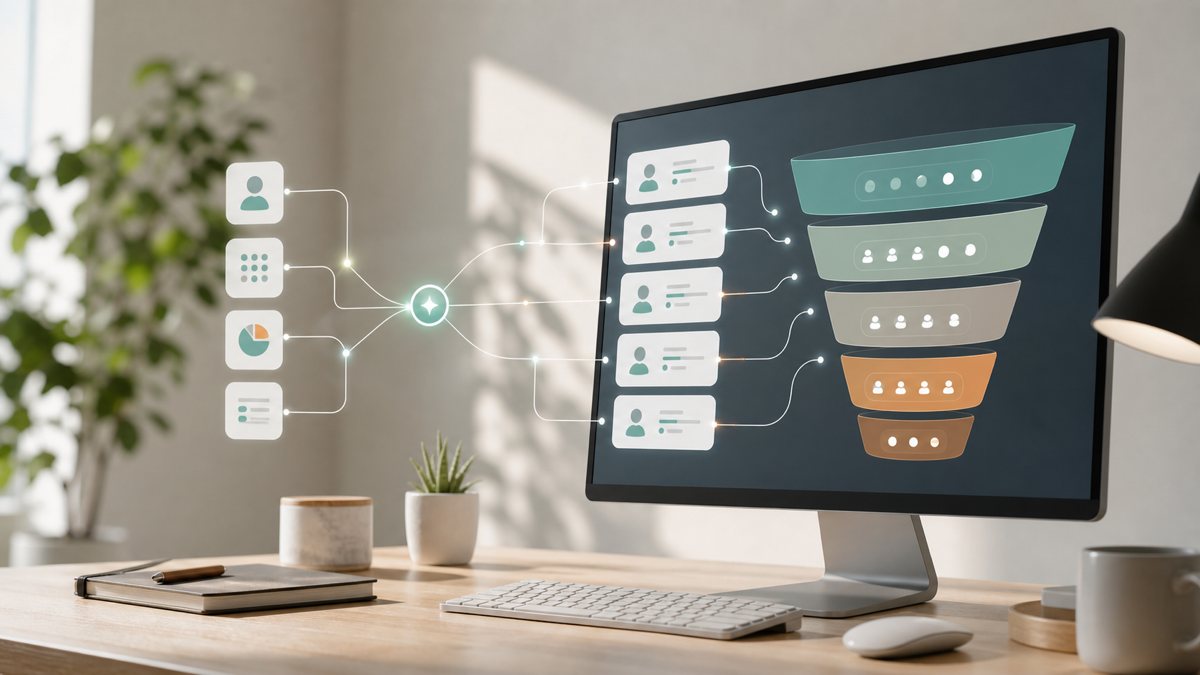
Lead generation is a pipeline, not a product. AI shows up at specific stages, not as a single button. A real system usually chains these together:
- Sourcing — pulling potential leads from data providers, forms, ad platforms, or your own site traffic.
- Enrichment — filling in the missing fields (company size, role, tech stack, contact details) from third-party APIs.
- Scoring — ranking each lead by how likely it is to buy, using your historical win/loss data rather than a gut-feel points system.
- Outreach — drafting and personalizing first-touch messages across email, LinkedIn, or SMS.
- Qualification — the conversation that decides whether a lead is worth a rep's time, increasingly handled by AI chat or voice before a human ever picks up.
The "AI" earns its keep in enrichment, scoring, outreach personalization, and qualification. Sourcing is mostly plumbing. An honest agency will tell you which stages AI genuinely improves for your business and which are just glue.
The components an automation agency actually builds
Here's what the work looks like under the hood, and roughly what each layer is worth as a build.
| Component | What it does | Typical build effort |
|---|---|---|
| Enrichment pipeline | Auto-fills lead data from APIs, dedupes against your CRM | Small–medium |
| Lead scoring model | Ranks leads by fit and intent using your win data | Medium |
| AI outreach engine | Personalizes first-touch messages at scale, respects opt-outs | Medium |
| Chat/voice qualifier | Screens inbound leads 24/7, books qualified ones | Medium–large |
| CRM + reporting glue | Routes, logs, and reports everything back into your stack | Small–medium |
Most of this is orchestration. The connective tissue is usually built on a workflow platform — n8n (self-hostable, the deepest agent control), Make, or Zapier — wired into an LLM for the language-heavy steps and your CRM for the source of truth. In 2026, all three platforms have first-class AI agents built in, so the question isn't "can it do AI" but "which one fits your data-privacy and cost constraints." If you're weighing the builder options, our n8n vs Make comparison covers exactly that tradeoff.
Where AI genuinely moves the needle
Three stages are where a well-built system outperforms a human team, and it's worth being specific about why.
Enrichment at scale. A rep researching one prospect takes minutes; an enrichment pipeline does thousands in the background and never gets bored. The AI's job here is mostly reconciliation — deciding that "Acme Inc" and "Acme, Incorporated" are the same account, and flagging low-confidence matches instead of silently guessing.
Scoring on your actual data. Generic lead scores are astrology. A model trained on your closed-won and closed-lost history learns the patterns specific to your business — which industries convert, which job titles stall, which lead sources waste everyone's time. That's the difference between "score of 87" and "prioritize this because it looks like the last ten deals you won."
Round-the-clock qualification. This is where 2026 AI shines, and it's the piece we at SprintX see move the numbers most. An AI chat or voice agent for sales can answer an inbound lead in seconds — day or night — ask the two or three questions that determine fit, and either book the meeting or politely route it away. Speed-to-lead is one of the few things in sales with a genuinely proven effect, and machines are simply faster than a rep who's asleep or on another call.
What it actually costs
There is no honest flat price for "AI lead generation services," because the cost is the sum of the tools you run plus the build. But you can reason about it in layers.
- Platform and data costs (ongoing). Your workflow tool, enrichment/data APIs, and CRM. As of mid-2026, self-hosting a workflow engine like n8n often runs roughly $5–$40/month in infrastructure, while managed platforms bill per operation or per task — verify current pricing on each vendor's site.
- AI model costs (ongoing, usage-based). Language steps run on token pricing. As of mid-2026, cheaper models are the right default for high-volume enrichment and drafting — for example, Claude Haiku 4.5 is roughly $1 per million input tokens and $5 per million output tokens — reserving pricier reasoning models for the few steps that need them. Confirm current rates on the vendor's pricing page.
- The build (one-time). Wiring the pipeline, training the scoring logic on your data, and integrating your CRM. Projects like this commonly land in the low-thousands-per-phase range, scoped in milestones.
The mistake founders make is anchoring on the model cost and ignoring the data-API bill, which is often the larger recurring line. A good agency itemizes all three before you commit.
Where these systems quietly fail
- Garbage in, confident garbage out. If your CRM history is messy, the scoring model learns the mess. Cleanup is unglamorous but it's the highest-leverage step.
- Over-automated outreach. AI that blasts thousands of near-identical "personalized" messages gets you flagged as spam and burns your domain reputation. Volume without restraint is a liability, not a feature.
- Silent cost creep. An outreach or enrichment loop with no guardrails can quietly run up API bills. Every production pipeline needs rate limits and a spend ceiling — a lesson many teams learn the expensive way, which is exactly why we build cost caps in from day one.
- No human in the loop for edge cases. The best systems escalate low-confidence decisions to a person instead of pretending certainty. Full autonomy on qualification sounds impressive and reads as reckless.
What this looks like in practice
A common project for us: a business getting inbound leads through a website form and a phone line that no one can answer fast enough. We unify the two — the form and the calls both flow into one pipeline, the lead gets enriched and scored, an AI voice agent qualifies phone leads in real time and books the good ones straight onto a calendar, and everything logs back to the CRM with an invoice or follow-up triggered automatically. It's not a magic lead-multiplier; it's the same leads, handled instantly and consistently, so fewer of them slip through the cracks. That "capture and qualify everything, 24/7" outcome is what most buyers actually mean when they ask for AI lead generation.
Frequently asked questions
What's the difference between AI lead generation services and buying a lead list? A lead list is static data you rent; AI lead generation is a system that continuously sources, enriches, scores, and qualifies leads from your own channels and routes the good ones to your team. Lists go stale the moment you buy them. A pipeline keeps working and improves as it learns from your outcomes.
Can AI actually qualify leads, or just collect them? It can qualify, within limits. An AI chat or voice agent can ask your qualifying questions, check answers against your criteria, and book or route accordingly 24/7. What it shouldn't do is make high-stakes judgment calls with no human fallback — the reliable pattern is AI handles the clear cases and escalates the ambiguous ones.
How much do AI lead generation services cost per month? There's no flat rate — it's your platform and data-API subscriptions plus usage-based AI model costs, on top of a one-time build. As of mid-2026, expect the recurring tooling to be modest and the data/enrichment APIs to often be the largest line. Always get the three layers itemized before signing.
Do I need a data scientist to run lead scoring? No. A well-built scoring setup is trained once on your historical win/loss data and then runs automatically inside your pipeline. You need clean CRM data more than you need a data scientist. The agency handles the modeling; your job is to keep feeding it accurate outcomes.
Want lead generation that captures and qualifies every inbound — not a list you'll regret buying? SprintX builds AI lead pipelines on a fixed-scope quote: enrichment, scoring on your own win data, and 24/7 chat or voice qualification wired into your CRM, with spend caps built in. You own the workflows and the accounts. Tell us how leads reach you today and we'll map the automation.