Code Review as a Service: An Outside Expert Audit of Your Codebase
When to commission an outside code review, what a professional audit actually checks, what it costs in 2026, and how to choose a reviewer you can trust with your repo.
 SprintX Team8 min read
A developer hands you a finished app, or you're about to acquire one, or you've been quietly wondering whether the contractor who built your product cut corners you'll pay for later. You can't read the code, so you're trusting on faith. That's exactly the moment an outside code review earns its fee: a senior engineer who has no stake in defending the work reads the actual codebase and tells you, in plain language, what's solid, what's risky, and what will cost you.
This guide is for the non-technical founder, the buyer doing due diligence, or the operator who inherited a codebase and needs an honest second opinion. What a code review service actually checks, when it's worth it, what it costs in 2026, and how to pick a reviewer you can trust with your repository.
When you actually need an outside code review
A review is worth commissioning at specific moments, not as a vague "just in case":
- Before you accept final delivery. A freelancer or agency says it's done. A review tells you whether "done" means production-ready or just demo-ready.
- When you inherit a codebase. The original developer vanished, or you're taking over someone else's project and need to know what you're standing on.
- Before an acquisition or investment. Technical due diligence: is the code an asset or a liability hiding under a nice UI?
- When things feel wrong. Slow releases, frequent breakage, an app that "works locally but not in production" — symptoms of problems a review surfaces.
- Before a rebuild decision. Fix or replace? A review gives you the facts to choose instead of guessing.
If any of these describe you, a review is cheap relative to the cost of finding out the hard way. The classic case is an app that runs fine on the developer's laptop and falls over in the real world — the exact problem we unpack in why an app works locally but not in production.
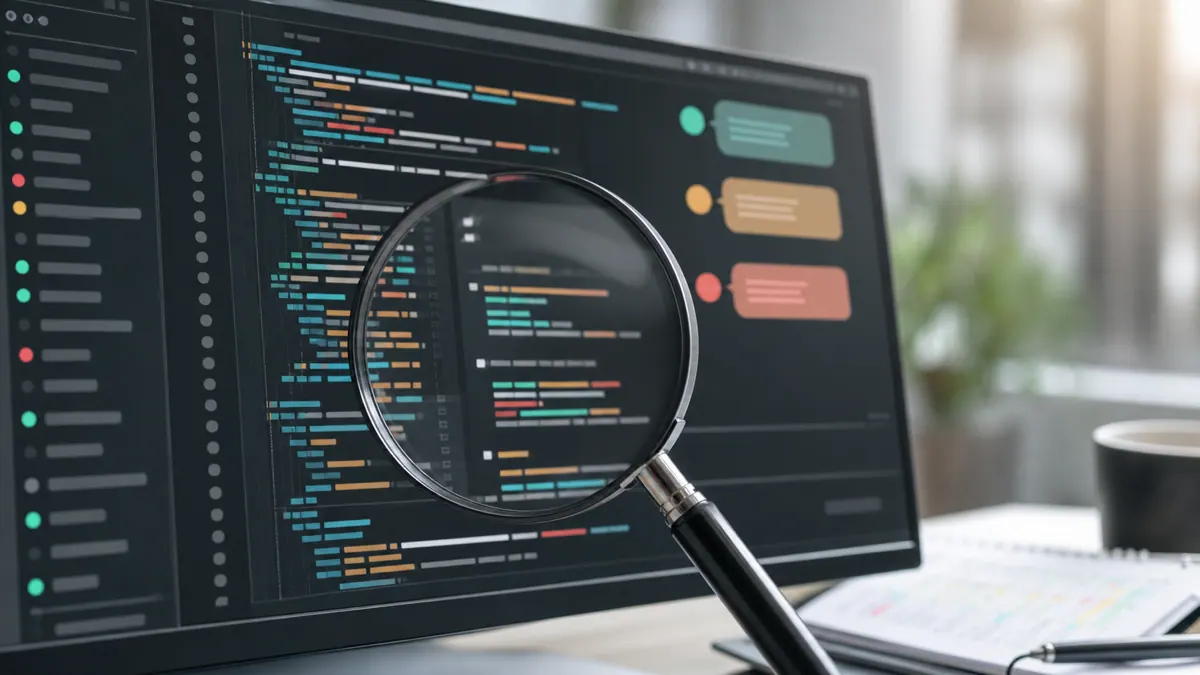
What a professional code review actually checks
A real audit goes well past "does it run." A thorough review covers:
| Area | What's examined | Why it matters to you |
|---|---|---|
| Security | Secrets in code, injection risks, auth flaws, dependency vulnerabilities | The stuff that gets you breached or sued |
| Architecture | Structure, separation of concerns, scalability | Whether it survives growth or collapses under it |
| Code quality | Readability, duplication, maintainability | How expensive the next change will be |
| Testing | Coverage, CI, whether tests actually run | Whether changes break things silently |
| Dependencies | Outdated or end-of-life libraries and runtimes | Security and future-proofing (e.g. running on Node.js 24 LTS, not an EOL version) |
| Data & config | Database design, migrations, secrets handling | Data loss and downtime risk |
| Documentation | Setup, deployment, onboarding | Whether anyone but the author can maintain it |
The output should be a written report you can actually read: a prioritized list of findings — critical, important, nice-to-have — each with what's wrong, why it matters, and what it takes to fix. A report full of jargon with no severity ranking or business translation isn't a review, it's a code dump.
Special case: AI-generated and vibe-coded apps
A growing share of the codebases we review in 2026 weren't written line by line — they were generated with tools like Lovable, Bolt, or Cursor, or assembled from an AI agent's output. These ship fast and demo beautifully, and they hide a specific set of problems: secrets committed into the repo, no rate limiting on expensive API calls, authentication that looks fine but leaks, and database rules that were never tightened. If your app was built quickly with AI assistance, a review is more valuable, not less — the gap between "it works" and "it's safe to put in front of paying users" is exactly where these builds fail. We see the same pattern often enough to have written up how AI apps silently burn API credits, which almost always traces back to something a review would have caught.
What this looks like in practice
A common engagement: a founder has an app a previous developer delivered, something feels off, and they need to know whether to keep building on it or start over. We take read access to the repo (under NDA), spend a fixed number of days reading it against the checklist above, and deliver a written report plus a walkthrough call in plain English — no jargon dump. Often the verdict is reassuring with a short fix list; sometimes it's "the foundation is sound but auth and the database rules need work before launch," and occasionally it's "this will cost more to salvage than to rebuild the risky parts." Either way the founder can decide with facts. Fixed-scope reviews like this typically land in the low-thousands range depending on codebase size, and they frequently roll straight into a stabilization phase to fix what was found.
What a code review costs in 2026
Cost tracks codebase size and depth. As of mid-2026, reasonable ranges — hedged, not quotes:
| Scope | Typical range | What you get |
|---|---|---|
| Focused review (small app / single concern) | ~$500 – $1,500 | Targeted audit, prioritized findings |
| Standard codebase audit | ~$1,500 – $5,000 | Full review, written report, walkthrough |
| Deep audit + due diligence | $5,000+ | Large or acquisition-grade, security-focused |
Beware two extremes. A "review" priced at a few hundred dollars for a large app is a skim, not an audit. And a fully automated scan sold as a human review misses architecture and context entirely — automated tools are useful as a first pass, but they can't tell you whether the design will survive your next year of growth.
How to choose a code review service
Five checks:
- A senior person does the reading. Ask who actually reviews it — a junior running a linter isn't what you're paying for.
- The deliverable is a prioritized, plain-language report. Severity ranked, business impact explained, fixes estimated.
- They're comfortable being blunt. A reviewer who only softens findings to keep you happy is worthless. You're paying for the truth.
- They handle your repo responsibly. NDA, read-only access, no keeping copies. Trust at the "share your repo" moment is the whole game.
- They separate review from rebuild. A reviewer who finds fifty "critical" issues that all require hiring them is suspect. Findings should be honest whether or not you hire them to fix anything.
If the review turns up structural problems, the natural next step is a maintenance or stabilization plan — see website maintenance plans for how ongoing care is scoped once the one-time issues are fixed.
Frequently asked questions
How much does a code review service cost? As of mid-2026, a focused review of a small app runs roughly $500–$1,500, a standard full codebase audit about $1,500–$5,000, and a deep or acquisition-grade audit $5,000 and up. The main driver is codebase size and how deep the security and architecture review goes.
What does a code review actually check? Security (secrets, injection, auth, vulnerable dependencies), architecture and scalability, code quality and maintainability, test coverage, outdated dependencies, data and config handling, and documentation. The deliverable should be a prioritized, plain-language report you can act on.
Can you review an app built with AI or a no-code tool? Yes — and it's often more valuable for those, because AI-generated and vibe-coded apps commonly ship with committed secrets, missing rate limits, weak auth, and untightened database rules. A review finds the gap between "it demos" and "it's safe for real users."
Is a code review the same as a security audit? They overlap but aren't identical. A code review covers security alongside architecture, quality, testing, and maintainability. A dedicated security audit or penetration test goes deeper on attack surface specifically — a good reviewer will tell you if you need that as a separate engagement.
If you're trusting a codebase on faith, a fixed-scope review replaces the faith with facts. SprintX audits codebases — including AI-generated and vibe-coded apps — under NDA with read-only access, and delivers a prioritized, plain-language report plus a walkthrough call, no lock-in and no obligation to hire us for the fixes. Send us the repo and we'll tell you honestly what you're standing on.
Engineering and operations
Once it’s live, we keep it healthy.
Monitoring, backups, security updates and a monthly health report you can read in ten minutes.
Keep reading.
More on engineering and operations
Engineering and operations · 14 Aug 2026 · 8 min read
Documenting a Codebase So the Next Engineer Can Take Over
Not a wiki nobody reads — the specific short documents that decide whether your next engineer ships in week one or spends a month reverse-engineering.
Engineering and operations · 13 Aug 2026 · 7 min read
Implementing Roles and Permissions Without Painting Yourself In
Most permission systems fail the first time a customer asks for something slightly unusual. Here is how to build one that bends instead of breaking.
Engineering and operations · 13 Aug 2026 · 8 min read
Versioning an API Before Anyone Depends On It
You do not need three API versions. You need one, plus the discipline and the mechanism to introduce a second the day you genuinely cannot avoid it.