Zendesk Alternatives in 2026: Cheaper Support Stacks Compared
A 2026 comparison of Zendesk alternatives and cheaper support stacks — from lean help desks to AI-first tools to custom builds.
 SprintX Team8 min read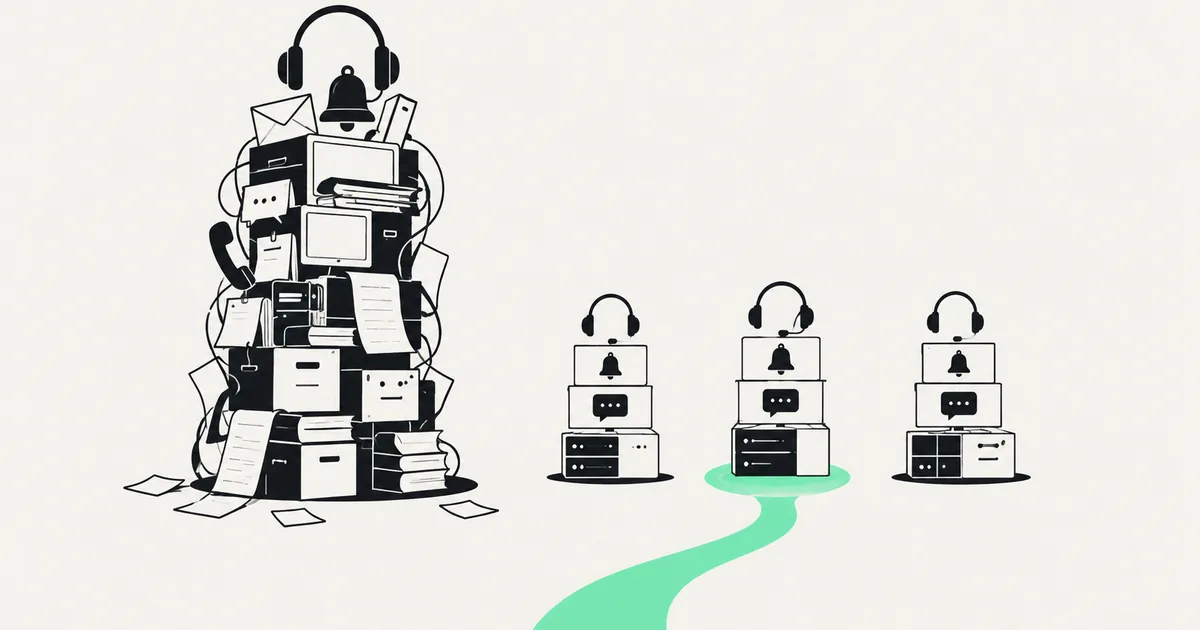
Zendesk is the default for a reason — it is mature, powerful, and does everything. It is also the tool small teams most often feel is too much: too many features they never touch, per-agent pricing that climbs as they grow, and add-ons that quietly push the bill higher every renewal. If you have opened your invoice and thought "we are paying enterprise prices for a support inbox," you are the reason "Zendesk alternatives" is one of the most searched support queries of 2026.
This is a practical comparison of what to move to and when. There is no single winner — the right answer depends on your volume, your team, and how much of your support could be handled by AI before a human ever sees it. Let us break the options into the categories that actually matter.
Why teams leave Zendesk
Before comparing alternatives, it helps to name what people are actually escaping. In our experience the reasons cluster into a few themes:
- Price at scale. Per-agent pricing plus add-ons means the cost grows with your team, not with the value you get.
- Complexity. A small team using 10% of a large platform is paying for the other 90% in both money and confusion.
- AI as an upsell. Modern support is increasingly AI-first, and bolt-on AI features are often the most expensive tier.
- Lock-in. Workflows, macros, and integrations built over years make leaving feel harder than it is.
Knowing which of these is your real pain point tells you which category of alternative to look at.
The four categories of Zendesk alternative
Not all alternatives compete on the same axis. They fall into four groups.
| Category | Best for | Trade-off |
|---|---|---|
| Lean help desks | Small teams wanting simpler, cheaper email support | Fewer enterprise features |
| All-in-one suites | Teams wanting CRM + support + marketing together | You are inside another ecosystem |
| AI-first support tools | High ticket volume you want deflected automatically | AI quality varies; needs good content |
| Custom / composable stack | Unusual workflows or heavy volume where per-seat pricing hurts | Upfront build, but you own it |
Lean help desks
If your pain is "Zendesk is too much for what we do," a lighter help desk is the obvious move. These tools focus on shared inboxes, simple ticketing, and a knowledge base, usually at a lower per-agent price and with far less to configure. You lose some enterprise-grade routing, reporting depth, and app-marketplace breadth — but most small teams never used those anyway. This is the lowest-effort switch and the right call for a lot of businesses.
All-in-one suites
If you are also shopping for a CRM or already live inside one, an all-in-one suite that bundles support with sales and marketing can consolidate tools and cut total spend. The catch is that you are trading one ecosystem for another — the support module is rarely best-in-class, and you inherit the suite's pricing model. Good when consolidation is the goal, less good when support quality is paramount.

AI-first support tools
This is where 2026 gets interesting. A large share of support tickets are repetitive questions already answered in your docs. AI-first tools aim to deflect those automatically — resolving common questions before a human is involved and only escalating the genuinely tricky ones. Done well, this changes the economics entirely, because your cost stops scaling linearly with ticket volume.
The quality varies enormously and depends heavily on the content you feed it. A retrieval-augmented (RAG) support assistant grounded in your real help articles and past tickets can resolve a meaningful chunk of volume; a generic bot bolted on badly just annoys customers. We break down how these actually work in AI chatbots for customer service, and the distinction between a scripted bot and a real agent in AI agent vs chatbot.
Custom or composable support stacks
For teams with unusual workflows, high volume, or a real allergy to per-seat pricing, assembling your own stack is increasingly viable. The pattern: a straightforward ticketing or inbox backbone, plus an AI deflection layer built on your own content, wired to your existing tools. You pay to build it once and then own it, instead of renting per agent forever. This is not for everyone — it only pays back above a certain scale — but at that scale it can be dramatically cheaper than an enterprise seat count.
A note on pricing (and why we are not quoting exact numbers)
Support tool pricing changes constantly, is usually per-agent-per-month with add-ons, and varies by contract — so any specific figure we printed would be stale or misleading within a quarter. The durable truth as of mid-2026: lean help desks generally undercut Zendesk on per-agent cost, all-in-one suites compete on bundled value rather than raw price, and AI-first or custom approaches change the shape of the cost by deflecting volume so you need fewer agents in the first place. Always confirm current pricing on each vendor's site, and model it against your real ticket volume and headcount, not a sticker price.
How to actually choose
Work through these questions in order:
- What is your real pain — price, complexity, or AI? That picks your category.
- What is your ticket volume, and how repetitive is it? High and repetitive means AI deflection is where the savings are.
- How custom are your workflows? Standard workflows fit off-the-shelf tools; unusual ones may justify a custom stack.
- What is the switching cost? Migrating macros, knowledge base, and integrations has a real cost — factor it in.
- Where do you want your money going — seats or an asset you own? That is the off-the-shelf vs custom decision.
What this looks like in practice
A recent client project involved a growing team drowning in repetitive support tickets and unhappy with a rising per-agent bill. Rather than simply swapping one help desk for another, we built an AI deflection layer in front of their existing inbox: a retrieval-based assistant grounded in their real help articles and resolved tickets that answered common questions instantly and cleanly escalated anything it was unsure about to a human. We also bridged their support tooling to their other systems via API so nothing lived in a silo. The result was fewer tickets reaching agents and a cost curve that no longer rose in lockstep with volume. Work like this typically runs in fixed-scope phases, and the client owns the whole thing. If you are consolidating a broader tool sprawl, our guide to choosing an AI automation partner is a useful companion read.
Frequently asked questions
What is the best cheap alternative to Zendesk? There is no single best — it depends on your pain point. If Zendesk simply feels too heavy, a lean help desk is the cheapest, lowest-effort switch. If your real problem is ticket volume, an AI-first approach that deflects repetitive questions usually saves more than any per-agent discount, because it reduces how many agents you need.
Can AI really replace part of my support team? It can handle a meaningful share of the repetitive, already-documented questions and escalate the rest — which is different from replacing your team. The quality depends entirely on grounding the AI in your real help content and past tickets. A generic bot bolted on badly does more harm than good.
Is it cheaper to build a custom support stack than pay for Zendesk? Above a certain scale, often yes, because you replace forever-recurring per-seat costs with a one-time build you own. Below that scale, off-the-shelf tools are cheaper. The tipping point depends on your agent count and ticket volume, so model both before deciding.
How hard is it to migrate off Zendesk? The main costs are moving your knowledge base, macros, and integrations, and retraining your team. It is very doable and usually less painful than it feels, but factor the switching cost into any comparison rather than looking at subscription price alone.
Not sure whether to switch help desks or add an AI layer to the one you have? SprintX designs support stacks that cut cost without cutting quality — off-the-shelf, AI-first, or a custom build you own — fixed-scope milestones and NDA-friendly. Tell us your ticket volume and we will map the cheapest stack that actually fits.
Cost, hiring and outsourcing
Start with a project, keep us on, or let us look after it.
Three ways to work with us, and how the first weeks run.
Keep reading.
More on cost, hiring and outsourcing
Cost, hiring and outsourcing · 18 Jul 2026 · 8 min read
FlutterFlow vs Bubble: Which No-Code App Builder Should You Pick?
A practical FlutterFlow vs Bubble comparison for founders deciding between a native mobile builder and a web app builder, with honest trade-offs.
Cost, hiring and outsourcing · 18 Jul 2026 · 8 min read
Synthflow vs Vapi vs Retell: Choosing a Voice AI Platform in 2026
A hype-free 2026 comparison of Synthflow, Vapi, and Retell — no-code ease versus developer control — and how to pick the right voice AI platform.
Cost, hiring and outsourcing · 18 Jul 2026 · 8 min read
LangChain vs LlamaIndex in 2026: Which for Your RAG App?
A practical, hype-free comparison of LangChain and LlamaIndex for building RAG and agent apps in 2026 — strengths, overlap, and how to choose.