AI Agent Development Platforms, Tools & Frameworks Compared (2026)
An honest 2026 comparison of the platforms, frameworks, and tools for building AI agents — and how to choose the right layer for your project.
 SprintX Team9 min read
"We need an AI agent" is where most 2026 projects start, and "which platform do we build it on" is where most of them stall. The landscape is genuinely confusing: no-code canvases, code frameworks, hosted agent runtimes, and vendor SDKs all call themselves "agent platforms," and they sit at completely different levels of the stack. Pick the wrong layer and you either hit a ceiling in a month or take on far more engineering than the job needed.
This guide cuts through it. What an agent platform actually is, the categories that matter in 2026, how they compare, and a simple way to choose the layer that fits your project instead of the one with the loudest marketing.
What "agent platform" even means
An AI agent is a system that takes a goal, decides on steps, calls tools or data to carry them out, and loops until it is done — as opposed to a chatbot that just answers. The difference between an AI agent and a chatbot is autonomy and tool use. "Agent platforms" help you build that loop, and they fall into four layers:
- No-code / visual automation platforms — build agents by wiring nodes in a canvas.
- Code frameworks — libraries for engineers to build agents in Python or TypeScript.
- Vendor agent SDKs & runtimes — the model provider's own kit for building and hosting agents.
- The connective layer (MCP) — the standard that lets any agent talk to your tools and data.
Most real systems combine layers. Knowing which is which is the whole game.
Layer 1: No-code / visual automation platforms
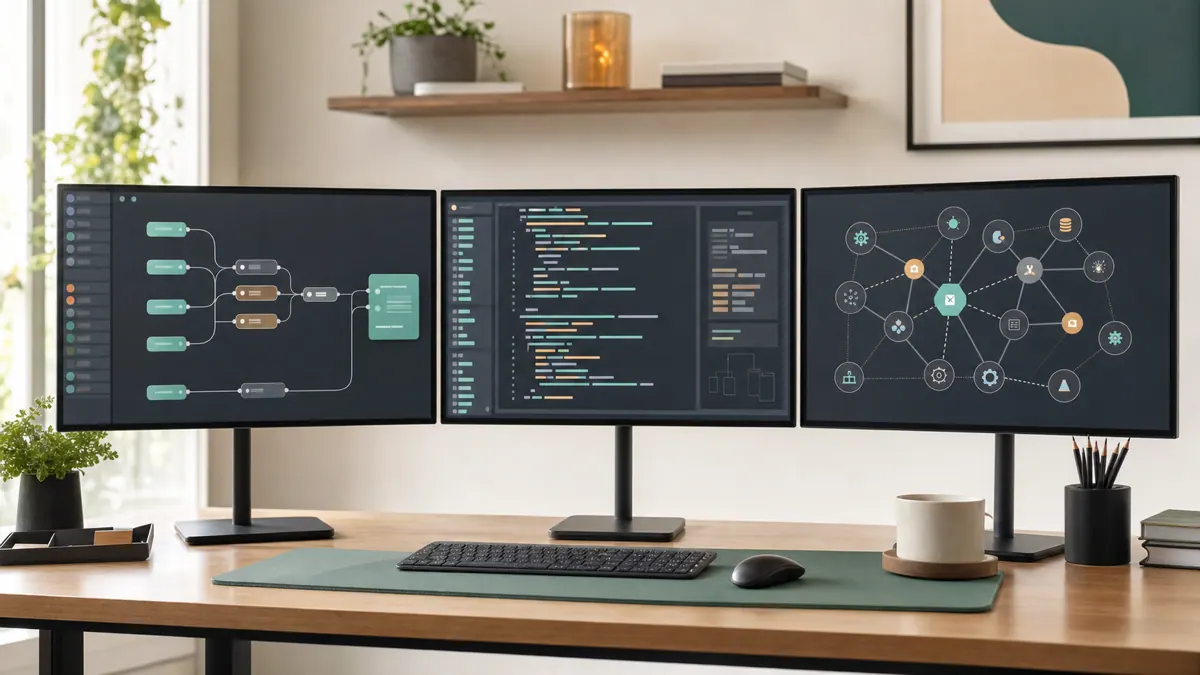
These let you build agents by dragging nodes and connecting apps — the fastest path from idea to working automation.
- n8n — as of 2026, n8n 2.0 brought native LangChain support, a large library of AI nodes, and an Agent node with tool-calling and memory. It is self-hostable and free for internal use under its Sustainable Use License, which makes it the pick when you want deep control and to keep data in-house. See our n8n primer for a deeper look.
- Make — cloud-only visual canvas that added native AI Agents and a natural-language builder in 2026. Slick and fast for teams that do not want to self-host.
- Zapier — cloud-only, with Zapier Agents and Zapier MCP reaching across thousands of apps. The widest integration library; per-task billing.
The trade-off is the usual no-code ceiling: brilliant for connecting apps and running defined logic, harder when your agent needs bespoke reasoning, custom UI, or logic the nodes cannot express. Our n8n vs Make comparison goes deeper on that choice.
Layer 2: Code frameworks
When the logic outgrows a canvas, engineers reach for frameworks. In 2026 the two mature workhorses are LangChain (edges ahead on agent orchestration) and LlamaIndex (edges ahead on retrieval quality), and they have converged toward production RAG and agent patterns. These give you full control over the agent loop, memory, and tool calls — at the cost of needing real engineering.
Frameworks are the right layer when your agent has non-trivial branching, needs tight integration with your own data and services, or must live inside a larger application rather than a workflow tool.
Layer 3: Vendor agent SDKs and runtimes
The model providers now ship their own agent kits. Anthropic's Claude Agent SDK (note: renamed from the old "Claude Code SDK") gives you an agent loop tuned for its models, and its Managed Agents offering hosts the loop and sandbox for you. OpenAI moved its agent story onto the Responses API — and importantly, its older Assistants API is being sunset in 2026, so you should not start new builds on it. These SDKs are excellent when you are committed to one provider and want first-party tooling; the trade-off is tighter coupling to that vendor.
Layer 4: MCP — the connective tissue
The most important shift in 2026 is not a platform at all. MCP (Model Context Protocol) is now the de facto, vendor-neutral standard for connecting agents to tools and data — adopted across Anthropic, OpenAI, Google, Microsoft, and AWS, and donated to the Linux Foundation. Think of it as USB-C for AI: build your tool integrations once against MCP, and any compliant agent can use them.
It is not a whole platform — it is the layer that lets the others talk to your systems without bespoke glue. One fair caveat: MCP's rapid, universal adoption also surfaced real security concerns in early 2026 (tool-poisoning and cross-tenant leakage among them), so treat tool permissions and trust boundaries seriously rather than wiring everything up blindly.
How the layers compare
| Layer | Examples | Best for | Watch out for |
|---|---|---|---|
| No-code / visual | n8n, Make, Zapier | Fast automations, app-to-app agents | Ceiling on custom logic/UI |
| Code frameworks | LangChain, LlamaIndex | Bespoke reasoning, deep data integration | Needs real engineering |
| Vendor SDK/runtime | Claude Agent SDK, OpenAI Responses API | First-party tooling, single-provider builds | Vendor coupling |
| Connective standard | MCP | Reusable tool/data connections | Security, permissioning |
Notice these are not competitors so much as levels. A production agent might use n8n to orchestrate, a framework for a tricky reasoning step, a provider SDK for the model loop, and MCP to reach your data.
How to choose the right layer
Answer these in order:
- Can a visual tool express your logic? If yes and you want speed, start no-code (n8n if you want self-hosting and control, Make/Zapier for hosted convenience).
- Does the agent need bespoke reasoning, custom UI, or to live inside your app? Then a code framework belongs in the stack.
- Are you committed to one model provider? Their SDK/runtime buys you polish — accept the coupling.
- Does the agent touch your internal tools or data? Plan for MCP as the connection layer, with real attention to permissions.
- Who owns and hosts it? For control, cost, and no lock-in, self-hostable pieces (n8n, your own framework code, your API keys) win. This mirrors the build vs buy logic for chatbots.
The failure mode is choosing a single "platform" and forcing the whole project through it. Real agents are layered — pick each layer for what it is good at.
What this looks like in practice
A common build for us: a client wants an agent that answers questions grounded in their private documents and can take a couple of actions in their systems. We do not force that onto one tool. Retrieval runs through a framework with a vector store; the action-taking connects through MCP to their internal tools with scoped permissions; orchestration and scheduling sit in self-hosted n8n so nothing leaves their infrastructure; and it runs on their own API keys across whichever model family fits each step. The client owns every layer — code, prompts, keys, and the running system. Projects like this usually land as fixed-scope phases rather than an open-ended engagement — the way SprintX structures agent builds.
Frequently asked questions
What is the best AI agent development platform in 2026? There is no single best — it depends on the layer you need. n8n is the strongest pick when you want visual building with self-hosting and control; LangChain and LlamaIndex lead for code-level agent and retrieval work; vendor SDKs like the Claude Agent SDK suit single-provider builds; and MCP is the standard for connecting any agent to your tools.
Do I need to know how to code to build an AI agent? Not for simpler agents — no-code platforms like n8n, Make, and Zapier can build capable app-to-app agents visually. You need engineering once the agent requires bespoke reasoning, custom interfaces, or deep integration into your own application.
What is MCP and why does it matter for agents? MCP (Model Context Protocol) is the vendor-neutral standard, adopted across the major AI providers in 2026, for connecting agents to tools and data. It lets you build an integration once and reuse it with any compliant agent — though its rapid adoption also means you should take tool permissions and security seriously.
Should I use one platform or combine several? Most production agents combine layers: a visual orchestrator, a code framework for tricky logic, a model SDK, and MCP for tool connections. Choosing each layer for what it does best beats forcing an entire project through a single "platform."
Trying to figure out the right stack for your agent? SprintX designs and builds AI agents across the right mix of layers on a fixed-scope, milestone-based quote — self-hostable where it matters, and yours: you own the code, prompts, and keys, with no lock-in. Tell us what the agent should do and we will scope the stack honestly before you commit.
AI agents and automation
AI agents that do the work.
We build agents and automations for the repetitive work your team does by hand, and measure what they save.
Keep reading.
More on ai agents and automation
AI agents and automation · 18 Jul 2026 · 8 min read
AI Agent Development Services: Custom Agents That Actually Ship
A practical guide for founders evaluating an AI agent development company: what these agents really do, what they cost, and how to choose a team that ships production, not demos.
AI agents and automation · 18 Jul 2026 · 8 min read
How to Build an AI Agent in 2026 (Architecture, Tools, Pitfalls)
A practical, founder-friendly guide to how to build an AI agent that actually works in production — the moving parts, the stack, and the mistakes to skip.
AI agents and automation · 12 Aug 2026 · 6 min read
A Caching Strategy That Cuts Your AI Bill
Cache the deterministic and reusable parts of your AI workflow without serving stale private data or pretending every model response is interchangeable.