Building a HIPAA-Compliant AI Chatbot: What It Really Takes
A grounded look at building a HIPAA-compliant AI chatbot — the BAAs, data handling, and architecture decisions that separate a compliant system from a liability.
 SprintX Team9 min read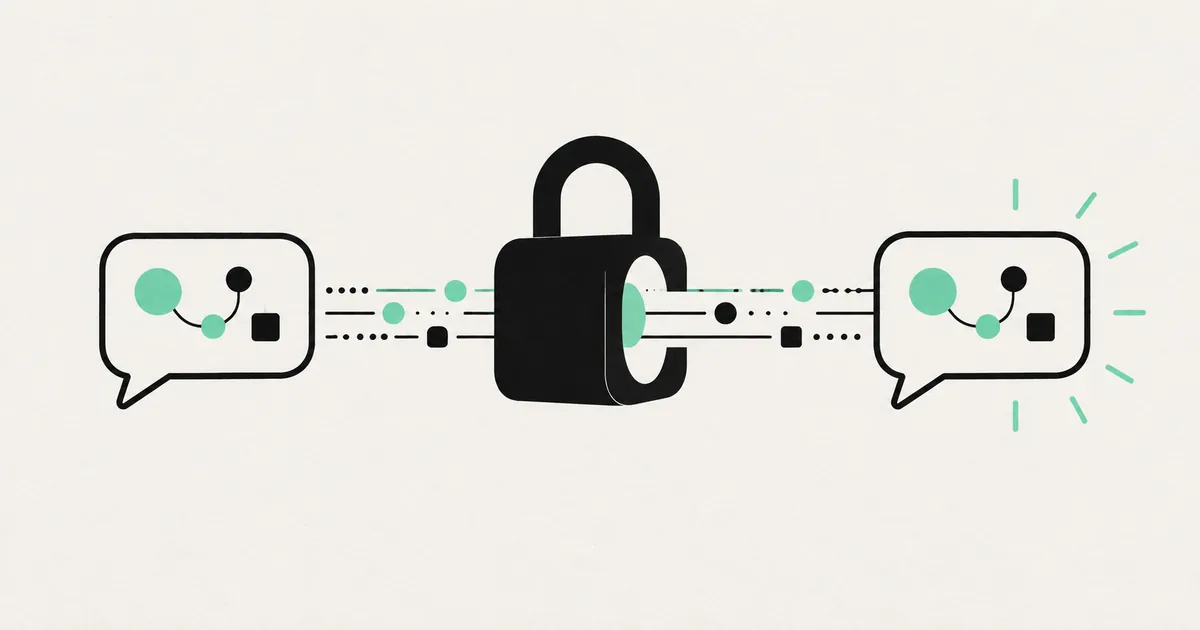
"Can we add an AI chatbot to our patient portal?" is one of the most common questions we get from clinics, telehealth startups, and health-tech founders. The follow-up question is the one that matters: "and can we do it without a HIPAA violation?" Because the moment a patient types their name and a symptom into your chatbot, you are handling protected health information (PHI) — and the rules that apply to your EHR now apply to your chatbot, your AI provider, and every log file in between.
The good news: a HIPAA-compliant AI chatbot is entirely buildable in 2026. The bad news: most of the "AI chatbot in five minutes" tutorials online will get you sued if you point them at real patients. Here is what compliance actually requires, in plain terms, and how the architecture has to change to support it.
First, what HIPAA actually asks of a chatbot
HIPAA is not a checklist you can buy your way out of with a badge on your website. It is a set of safeguards — administrative, physical, and technical — around PHI. For a chatbot, the parts that bite are concrete:
- PHI is anything that identifies a patient plus health context — name, contact details, an appointment reason, a symptom, even an IP address tied to a visit. If your bot touches it, it is in scope.
- Every vendor that processes PHI on your behalf needs a Business Associate Agreement (BAA). That includes your AI model provider, your hosting, your logging service, and your database host. No BAA, no PHI — full stop.
- You need access controls, audit logging, encryption, and a breach plan. Data encrypted in transit and at rest, who-saw-what logs, least-privilege access, and a documented response if something leaks.
The single most common mistake is treating the AI model as "just an API." It is a business associate the moment PHI flows to it, and it needs a signed BAA like any other.
The BAA is the load-bearing decision
Whether you can use a given AI provider for a HIPAA workload comes down to one question: will they sign a BAA covering the endpoints you use, and do they contractually agree not to train on your data? This changes by vendor and by plan, and it changes over time — so verify it directly with the vendor before you build, not from a blog.
As of mid-2026, the major AI providers offer enterprise or business tiers with BAAs and zero-retention options for healthcare workloads, but the specific terms, eligible models, and configuration steps differ. Some capabilities are available on managed cloud platforms (through their AI services) that already sit under an existing BAA, which is often the cleanest path. The rule of thumb: pick your model family for the workload, then confirm the compliant configuration before committing.
| Requirement | What to confirm with the vendor |
|---|---|
| Signed BAA | Covers the exact API/endpoints and models you will call |
| No training on your data | Contractual zero data-retention / no-training for your account |
| Data residency | Where inference and any transient data are processed |
| Logging controls | Whether prompts/outputs are retained on their side, and for how long |
| Model coverage | Which specific models the BAA and zero-retention apply to |
If a provider will not sign a BAA for the tier you can afford, that provider is off the table for PHI — no matter how good the model is. This is exactly the kind of constraint that should be settled in week one, not discovered in week six.

The architecture that keeps you covered
Compliance is mostly an architecture problem. The pattern that works is minimizing how much PHI reaches the model at all, and controlling everything that does.
1. Separate identity from content. Keep patient identifiers in your own secure database. When you send text to the model for a response, send the minimum necessary — and where possible, strip or tokenize direct identifiers so the model reasons over content without holding a full identity record.
2. Ground answers in verified sources. A general chatbot that free-associates medical advice is both a compliance and a safety risk. A retrieval-grounded design — a RAG chatbot that answers only from your approved clinical content and policies — is safer and more auditable. If RAG is new to you, start with what is a RAG chatbot.
3. Control every log. This is where teams get caught. Your application logs, your error tracker, and your analytics can all silently capture PHI. Every one of those either needs a BAA and the right retention settings, or needs PHI scrubbed before it is written. A logging service without a BAA that captures a patient message is a breach waiting to be found.
4. Lock down access and encryption. TLS in transit, encryption at rest, least-privilege roles, and audit logs of who accessed what. If you are on Postgres, this is also where row-level security does real work — our guide to Supabase row-level security roles shows how to enforce per-role data access at the database layer.
5. Consider keeping PHI on your own infrastructure. For the strictest workloads, a self-hosted or private-deployment model keeps sensitive data from ever leaving your environment. That trades some model capability for maximum control — we cover the tradeoffs in offline AI chatbot with RAG.
Design and scope decisions that reduce your risk
A lot of compliance risk is really scope discipline. The safest HIPAA chatbot is one that is deliberately limited to what it needs to do.
- Define what the bot is allowed to do. Booking, triage routing, answering policy and coverage questions, and pointing to resources are lower-risk than dispensing diagnoses. Decide the boundary and enforce it.
- Escalate clinical judgment to humans. The bot should recognize when it is out of its depth — anything that smells like an emergency or a real diagnosis — and hand off, fast.
- Collect the minimum necessary. Do not ask for a full history if a callback and a first name will do. Less PHI collected is less PHI to protect.
- Get informed consent where the interaction warrants it, and make the bot's limits clear to patients.
- Log immutably for audit, but scrub what does not need to be retained.
Here is what this looks like in practice. On healthcare-adjacent builds we have handled, the interesting work is almost never the model call — it is the data plane around it: which fields count as PHI, where they are allowed to travel, which vendors have BAAs, and how logging is scrubbed so a debugging tool does not quietly become a compliance hole. Get that plane right and the chatbot itself is the easy part. The same discipline applies to voice — if phone is your channel, see AI voice agent for healthcare.
What it costs and how long it takes
A compliant build costs more than a toy chatbot, mostly because of the architecture and the vendor diligence — not the AI itself. But it is not exotic. For small-to-mid healthcare businesses, a scoped chatbot with the compliance plumbing typically runs as fixed-scope milestones in the low-thousands-of-dollars range per phase, plus ongoing model and hosting usage. The variable that moves the number most is integration depth: a standalone FAQ bot is far simpler than one wired into an EHR and a scheduler.
One caution worth its own sentence: do not "add compliance later." Retrofitting HIPAA onto a chatbot that already logged PHI to a no-BAA service means you have already had a reportable exposure. Compliance is a week-one design constraint, not a launch-week checkbox.
Frequently asked questions
Can ChatGPT or Claude be used in a HIPAA-compliant chatbot? Only under the right agreement. You need a signed BAA from the provider covering the specific endpoints and models you call, plus a contractual no-training / zero-retention setup for your account. Confirm the current terms directly with the vendor before building — availability and eligible tiers change over time.
Is a BAA enough to make my chatbot HIPAA compliant? No. A BAA with your AI provider is necessary but not sufficient. You also need BAAs with every other vendor that touches PHI (hosting, logging, database), plus access controls, encryption in transit and at rest, audit logging, minimum-necessary data collection, and a breach plan.
What is the biggest hidden HIPAA risk in an AI chatbot? Logging. Application logs, error trackers, and analytics tools routinely capture message content, and if PHI lands in a service without a BAA or with long retention, that is a reportable exposure. Every log path must either sit under a BAA with correct retention or have PHI scrubbed before writing.
Should the model run on my own infrastructure for HIPAA? Not always — but it is worth considering for the strictest workloads. A self-hosted or private-deployment model keeps PHI from ever leaving your environment, at the cost of some capability and more ops work. For many clinics, a BAA-covered managed model with a tight data plane is the pragmatic choice.
If you are adding an AI chatbot to a patient-facing product, the model is the easy 20%. SprintX builds HIPAA-aware AI chatbots with the BAAs, PHI-minimizing architecture, scrubbed logging, and access controls handled from day one — fixed-scope milestones, NDA-friendly, and the code is yours to own. Get in touch and we will map a compliant build for your workflow.
AI agents and automation
AI agents that do the work.
We build agents and automations for the repetitive work your team does by hand, and measure what they save.
Keep reading.
More on ai agents and automation
AI agents and automation · 18 Jul 2026 · 9 min read
7 Intercom Alternatives in 2026 (And When a Custom Bot Wins)
A no-hype look at seven Intercom alternatives in 2026, what each is good for, and the point where a custom-built support bot becomes the smarter buy.
AI agents and automation · 18 Jul 2026 · 8 min read
Ecommerce Chatbot: Boosting Sales and Cutting Support Tickets
A practical look at how an ecommerce chatbot lifts sales and cuts support load, with real workflows, cost ranges, and a buyer-focused build plan.
AI agents and automation · 18 Jul 2026 · 9 min read
Chatbot Development Cost in 2026: RAG, Voice and Beyond
A practical, no-hype guide to chatbot development cost in 2026 — build ranges, running costs, and what pushes a RAG or voice bot up or down in price.