RPA vs AI Agents: Which Should Automate Your Back Office?
A decision guide to robotic process automation vs AI agents: what each is good at, where each breaks, costs, and how to pick the right tool for back-office work.
 SprintX Team9 min read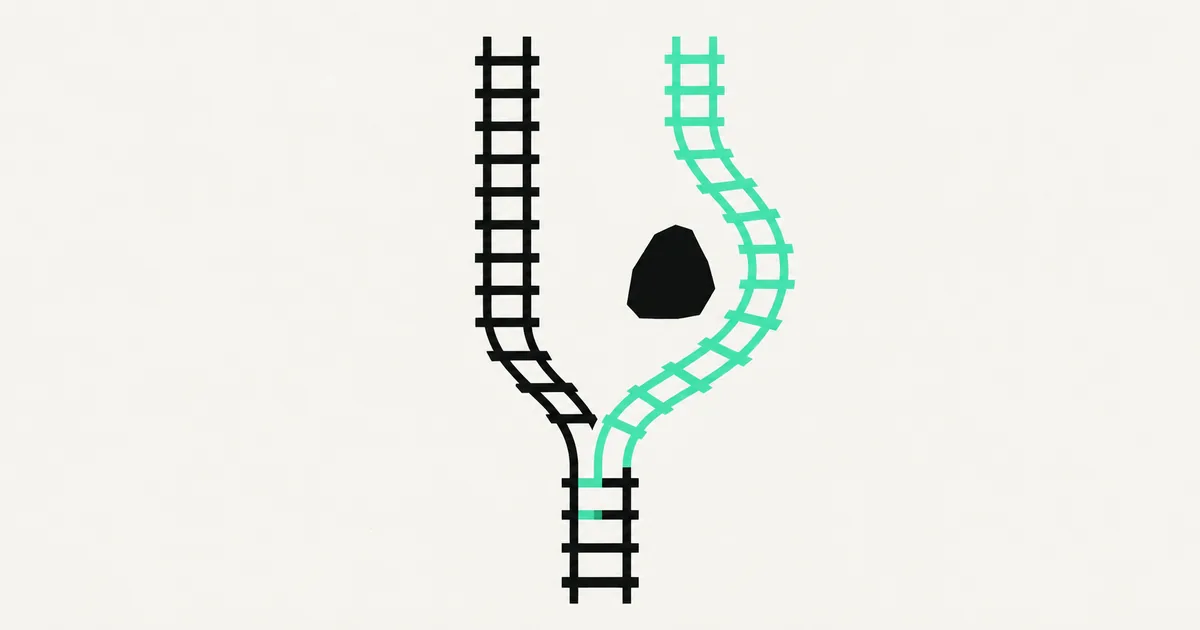
Every back office has a pile of work that is too repetitive for a smart person and too messy for a dumb script. Copy this invoice number into that system. Read the email, figure out what the customer wants, update three records. For fifteen years the answer to the first kind of task was robotic process automation (RPA) — software robots that click through screens like a person. Now there is a second answer, AI agents, and the two are genuinely different tools. Pick the wrong one and you either overpay for flexibility you do not need or buy a brittle bot that snaps the first time a screen changes.
This is the plain-English guide to which fits which job — and why the real answer for most teams is "both, in the right places."
The two approaches, honestly defined
Robotic process automation is software that mimics a human doing rule-based work on a computer: log into a system, read a field, type it somewhere else, click submit. RPA is deterministic — it does exactly what it was configured to do, the same way every time. It is fantastic at high-volume, structured, repetitive tasks with stable rules. Its weakness is that it is literal: change the layout of a screen or throw an unexpected input at it, and it breaks or does the wrong thing without noticing.
AI agents are powered by language models. Instead of following a fixed script, an agent is given a goal and a set of tools, and it reasons about how to reach the goal — reading unstructured input, making judgment calls, and adapting when things do not look exactly as expected. Its strength is handling ambiguity and language. Its weakness is that it is probabilistic: it can be wrong, so it needs guardrails, verification, and often a human check on consequential actions.
The one-line version: RPA follows rules; AI agents pursue goals.

Where each one wins
The choice comes down to the nature of the task, not which technology sounds more impressive.
Reach for RPA when the work is:
- Structured and rule-based. The inputs are predictable, the steps never vary.
- High-volume and repetitive. The same action thousands of times.
- Stable. The systems and screens do not change often.
- Zero-tolerance for creativity. You want the exact same output every single time — payroll runs, compliance filings, bulk data entry between fixed systems.
Reach for AI agents when the work involves:
- Unstructured input. Emails, PDFs, chat messages, documents that never follow one format.
- Judgment. "Is this a refund request or a complaint?" "Which of these does this apply to?"
- Adaptation. The process has exceptions and edge cases a script cannot enumerate.
- Language. Reading, summarizing, drafting, classifying, or responding in natural language.
Consider a real back-office task: processing incoming invoices. If every invoice arrives in one identical format from one portal, RPA nails it cheaply. If invoices arrive as varied PDFs and email attachments in a dozen layouts, an AI agent that can read them handles what RPA cannot. Same category of work, opposite right answer — because the input structure differs.
The comparison at a glance
| Factor | RPA | AI Agents |
|---|---|---|
| How it works | Follows fixed rules/scripts | Reasons toward a goal |
| Handles unstructured input | Poorly | Well |
| Handles exceptions | Breaks or needs a new rule | Adapts within reason |
| Predictability | Exact, deterministic | Probabilistic, needs checks |
| Reads/writes natural language | No | Yes |
| Breaks when a screen changes | Often | More resilient |
| Best task type | Structured, high-volume, stable | Messy, judgment-heavy, language-based |
| Main risk | Brittleness | Occasional wrong calls |
| Human oversight | Light (it is predictable) | Needed on consequential actions |
Neither column is "better." They are different instruments. The mistake is forcing a language-and-judgment task onto RPA (endless brittle rules) or throwing an AI agent at a task that is genuinely just "move field A to field B, forever" (unnecessary cost and variability).
Why 2026 is the "both, together" year
The old framing was RPA versus AI. The current reality is that the line is blurring, and the strongest setups combine them. An AI agent handles the messy front of a process — reading the document, understanding intent, deciding what should happen — and then calls deterministic, reliable automation to execute the structured back end.
This works cleanly now because of two shifts. First, the automation platforms most businesses actually use — the n8n, Make, and Zapier family — all added first-class AI agents in early 2026, so the "reasoning" and "rule-following" parts live in one workflow. Second, MCP (Model Context Protocol) became the standard way to give agents safe, structured access to real tools and data, so an agent can act in your systems without a swamp of custom integrations.
The result: you no longer choose one philosophy for the whole process. You use judgment where the task is ambiguous and deterministic steps where it is not — inside a single automation.
How to actually choose
A short decision path that holds up:
- Map the task's inputs. Structured and predictable → lean RPA. Unstructured or in natural language → lean AI agent.
- Count the exceptions. Few and enumerable → rules work. Many and fuzzy → you need reasoning.
- Check volume and stability. Enormous, unchanging volume → deterministic automation is cheap and safe. Moderate volume with variety → an agent earns its keep.
- Weigh the cost of a wrong action. High-stakes, must-be-exact → keep it deterministic, or keep a human in the loop on the agent's decisions.
- Look for the seam. Most real processes have a messy front and a structured back — split them, and use each tool where it belongs.
If you want a broader primer on the automation options before deciding, what is workflow automation sets the foundation, and AI agent vs chatbot clarifies what "agent" really means.
What this looks like in practice
A recurring project for us is unifying a back office that had grown into a mess of manual steps — calls and web forms feeding a calendar, invoices, and payments, with a person retyping data between each. The right build is rarely all-or-nothing. We put an AI agent where the input is messy and judgment is needed — reading a free-text request, classifying it, extracting the details — and deterministic workflow steps where the task is fixed: create the calendar invite, generate the invoice, send the receipt. The agent handles ambiguity; the reliable steps handle execution. Projects like this usually land in the low-thousands-per-phase range and pay for themselves in reclaimed hours, because you are automating the whole process instead of just the tidy parts.
A note on cost
Rough shape rather than a quote: traditional enterprise RPA carries per-bot licensing that can get pricey at scale, while AI agents cost mainly model usage (per token) plus the workflow platform. As of mid-2026, modern automation platforms that bundle both are often more economical for small-to-mid businesses than legacy RPA suites — but the real cost driver is scope and volume, not the label. Get a fixed-scope quote against your actual process rather than trusting a per-seat sticker price. For a deeper look, see AI automation cost.
Frequently asked questions
Is RPA dead now that AI agents exist? No. RPA is still the best tool for high-volume, structured, rule-based work where you need the exact same output every time and cannot tolerate variability. AI agents did not replace it — they extended automation into the messy, language-heavy tasks RPA could never handle. The strongest setups use both.
Can AI agents do everything RPA does? They can, but often should not. For a rigid, high-volume, must-be-exact task, deterministic automation is cheaper, faster, and more predictable than asking a reasoning model to do it. Use agents where judgment and unstructured input are involved, not where a simple reliable script suffices.
What is the difference between RPA and AI agents in one sentence? RPA follows fixed rules step by step; AI agents are given a goal and reason about how to reach it, adapting to messy input and exceptions. RPA is deterministic and brittle; agents are flexible but probabilistic and need guardrails.
Which is cheaper for a small business? It depends on the task, but as of mid-2026 modern platforms that combine AI agents with deterministic steps are often more cost-effective for small-to-mid businesses than legacy enterprise RPA licensing. The honest answer is to price it against your specific process rather than comparing sticker rates.
Not sure whether your back-office process wants rules, reasoning, or a mix of both? SprintX maps your workflow, puts AI agents where judgment is needed and deterministic automation where reliability matters, and ships it production-ready. Tell us what you are trying to automate and we will scope it as a fixed-price, milestone-based build — you own the whole thing.
AI agents and automation
AI agents that do the work.
We build agents and automations for the repetitive work your team does by hand, and measure what they save.
Keep reading.
More on ai agents and automation
AI agents and automation · 11 Jul 2026 · 8 min read
AI Agent vs Chatbot: What's the Real Difference?
A straight comparison of AI agents and chatbots — what separates them, where each fits, and how to choose without overbuying.
AI agents and automation · 18 Jul 2026 · 8 min read
What Is an MCP Server? A Plain-English Guide for Businesses (2026)
A no-jargon guide to MCP servers: what they are, why every major AI vendor adopted them, and how businesses use them to connect AI agents to real systems.
AI agents and automation · 18 Jul 2026 · 8 min read
AI Agent Development Services: Custom Agents That Actually Ship
A practical guide for founders evaluating an AI agent development company: what these agents really do, what they cost, and how to choose a team that ships production, not demos.