Agentic AI for Business: What It Is and Where It Pays Off in 2026

Written By
SprintX Team
AI & Product Engineering
July 18, 2026
10 min read

A founder-friendly guide to agentic AI for business in 2026 — what it is, how it differs from chatbots, where it genuinely pays off, and how to adopt it safely.
"Agentic AI" is the phrase every vendor bolted onto their homepage in 2026, and most of the time it means nothing more than "our chatbot, but we're charging more." That's a shame, because underneath the hype there's a genuine shift worth understanding — one that changes what AI can do for a business from answering questions to getting work done. The trick is telling the real thing apart from the marketing, and knowing the handful of places it actually pays off.
This is a plain-spoken guide for founders and operators: what agentic AI really is, how it differs from a chatbot, where it earns its keep in 2026, where it doesn't, what it costs, and how to start without setting money on fire.
What "agentic AI" actually means
A chatbot responds. An agent acts. That's the whole distinction, and everything else follows from it.
A traditional AI assistant takes your message and returns text. An agentic system takes a goal, breaks it into steps, uses tools to carry those steps out, checks the results, and adapts — with far less hand-holding. Give a chatbot "what's our refund policy?" and it tells you. Give an agent "refund this customer's last order and email them a confirmation" and it finds the order, issues the refund, drafts the email, and sends it.
Three capabilities separate agentic AI from a smart autocomplete:
- Planning — decomposing a goal into an ordered sequence of steps.
- Tool use — actually reaching into your systems to read data and take actions, not just describe them.
- Iteration — checking whether a step worked and adjusting, rather than firing once and stopping.
The dividing question, always, is "can it act?" Our deeper comparison in AI agent vs chatbot is the companion read if you want that line drawn in full.
Why 2026 is the year it became practical
Agentic AI isn't new as an idea, but a few things converged to make it actually deployable this year rather than a demo.
- The models got good enough at reasoning. Current frontier families — Claude's Opus 4.8 and Sonnet 5, the GPT-5 family, the Gemini 3 family — plan multi-step work reliably enough to trust with real tasks under supervision.
- MCP became the standard for tool access. Model Context Protocol is now the vendor-neutral way agents connect to tools and data, adopted across Anthropic, OpenAI, Google, Microsoft, and AWS, and governed under the Linux Foundation. That solved the "how does the agent safely reach my systems?" problem that used to block everything.
- The tooling matured. Agent frameworks and SDKs — the Claude Agent SDK, orchestration platforms, and automation tools like n8n 2.0 with its agent node — turned agent-building from research into engineering.
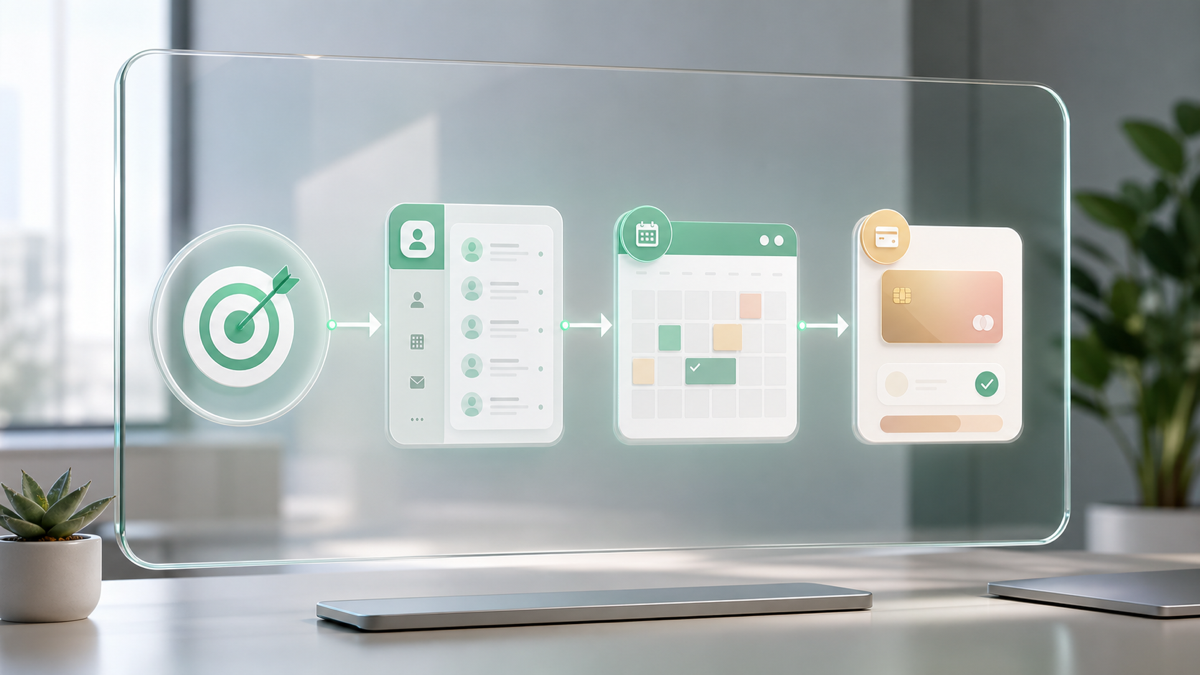
The result: an agent that can operate across your CRM, calendar, and payment system is now a build, not a science project. What it isn't is a magic autonomous employee — the winners in 2026 keep humans in the loop on the actions that matter.
Where agentic AI genuinely pays off
Agentic AI earns its cost where work is repetitive, multi-step, spans several systems, and follows rules — but is too fiddly for rigid automation. Some of the highest-return patterns we see:
| Use case | What the agent does | Why agentic beats a chatbot |
|---|---|---|
| Customer support triage | Reads the ticket, looks up the customer, checks orders, drafts or resolves | It acts across systems, not just answers |
| Appointment & booking ops | Qualifies the request, checks availability, books, sends confirmation | Completes the whole loop end to end |
| Lead qualification | Enriches the lead, scores it, routes it, logs to CRM | Multi-step judgment plus system writes |
| Invoice & billing workflows | Generates invoices, chases overdue, reconciles payments | Coordinates tools a chatbot only talks about |
| Internal ops assistants | Pulls data, updates records, schedules follow-ups across tools | One agent replaces manual tool-hopping |
| Research & document work | Gathers sources, extracts, summarizes with citations | Iterates until the task is actually done |
The common thread: each involves doing, across more than one system, with judgment in the middle. That's the sweet spot.
What this looks like in practice
A recent client project unified a messy operations flow: inbound calls and web-form requests, a calendar, an invoicing tool, and a payment system that previously required a person to shuttle information between all of them. We built an agent layer that qualified each request, checked availability and booked it, generated the invoice, and issued the receipt — with a human approval step on anything that moved money. The pieces already had APIs; the agent's job was the judgment and the orchestration that used to eat someone's whole afternoon. Work like this typically lands in phases in the low-thousands-per-phase range, and the phased approach matters: you prove the risky end-to-end path on a slice of real volume before scaling it.
Where it does NOT pay off (be honest here)
Agentic AI is the wrong tool at least as often as it's the right one. Skip it when:
- The task is a single, fixed step. If a human always does the exact same call in the exact same order, plain automation or a simple API integration is cheaper and more reliable. RPA vs AI agents breaks down that trade-off.
- You only need answers, not actions. A well-built RAG chatbot grounded in your documents is simpler and cheaper than an agent, and often all you need.
- Errors are catastrophic and unsupervised. If a wrong action can't be caught by a human before it does damage, the autonomy has to be dialed way down — sometimes to the point where an agent isn't worth it.
- The process itself is broken. Agents amplify whatever workflow they sit on. Automating a bad process just produces bad outcomes faster.
The maturity move in 2026 is starting narrow: one workflow, heavy human oversight, then widening autonomy only as the agent earns trust on real data.
What agentic AI costs to build
Cost tracks how many systems the agent touches, how much write access is involved, and how strict the guardrails need to be. Two cost centers matter: the build and the running cost.
| Item | Rough 2026 range | Notes |
|---|---|---|
| Single-workflow agent (read-mostly) | ~$2k – $5k | One workflow, a few tools, oversight |
| Multi-system agent with write actions | ~$5k – $12k+ (phased) | Approval gates, integrations, testing |
| Model/token usage (running) | Usage-based | e.g. Claude Sonnet 5 ~$3 in / $15 out per MTok, mid-2026 |
| Tool/infra hosting | Verify per-project | MCP servers, hosting, monitoring |
These are ballparks, not quotes. Running cost is easy to underestimate — an agent that reasons over many steps consumes more tokens than a one-shot chatbot, so the model choice (a cheaper Haiku-class model for routine steps, a stronger Opus- or Sonnet-class model for hard reasoning) is a real lever. For a fuller breakdown, AI automation cost walks through the moving parts.
How to start without setting money on fire
A sane adoption path, in order:
- Pick one painful, multi-step workflow that spans a couple of systems and eats real human hours.
- Keep a human on the destructive actions. Anything that moves money, deletes data, or contacts customers gets approval at first.
- Give the agent tool access through MCP, not a tangle of one-off integrations — it's safer and reusable. See custom MCP server development for what that involves.
- Instrument everything. Log every tool call so you can see what the agent did and why.
- Widen autonomy as trust grows, not before. Earn each step of independence with evidence on real data.
Done this way, agentic AI stops being a gamble and becomes a series of small, measurable bets.
Frequently asked questions
What is agentic AI in simple terms? It's AI that takes actions to accomplish a goal, not just AI that answers questions. An agentic system plans steps, uses your tools to carry them out, checks the results, and adapts — so instead of telling you how to refund a customer, it actually finds the order, issues the refund, and sends the confirmation.
How is agentic AI different from a chatbot? A chatbot responds with text; an agent acts across your systems. The dividing question is "can it do the task, not just describe it?" Agents plan, use tools, and iterate; chatbots answer. Many businesses need only a chatbot — you reach for agentic AI when the job involves multi-step work across several tools.
Is agentic AI worth it for a small business? It's worth it when you have a repetitive, multi-step workflow that spans a few systems and consumes real hours — support triage, booking ops, invoicing. It's not worth it for single fixed steps (use plain automation) or pure Q&A (use a RAG chatbot). As of mid-2026, a single-workflow agent is roughly $2k–$5k to build, plus usage-based model cost — so start with one workflow and human oversight before expanding.
Is agentic AI safe for business use? It can be, with the right guardrails — least-privilege tool access, human approval on destructive actions, full audit logging, and starting with narrow autonomy. The risk isn't the concept; it's deploying an unsupervised agent with broad write access on day one. Mature adopters widen autonomy gradually as the agent proves itself.
Wondering whether one of your workflows is a real fit for agentic AI — or just hype? SprintX builds production-ready AI agents and the MCP integrations behind them: scoped to one workflow first, with human approval on the actions that matter, full logging, and a definition of done that means "works in production." Tell us the workflow that's eating your team's hours and we'll scope it as a fixed-price milestone — you own the code, no lock-in.