How to Build an AI Agent in 2026 (Architecture, Tools, Pitfalls)
A practical, founder-friendly guide to how to build an AI agent that actually works in production — the moving parts, the stack, and the mistakes to skip.
 SprintX Team8 min read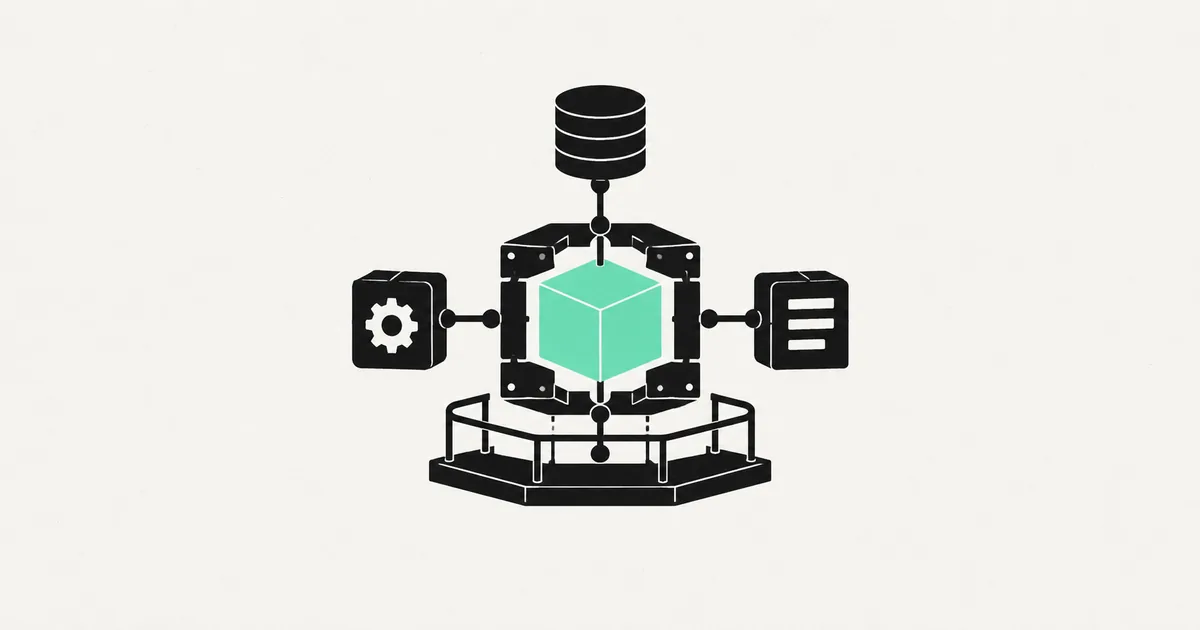
Most "AI agents" people show off are chatbots with a system prompt. They answer questions, and that is where the intelligence stops. A real agent does something: it reads a support ticket, looks up the order, checks the refund policy, and either issues the refund or escalates — then reports what it did. The difference between those two things is the difference between a demo and a tool your business relies on.
The good news for 2026 is that the plumbing has largely standardized. You no longer glue everything together by hand. But the failure modes are also well understood now, and most agent projects die from the same handful of mistakes. This guide walks through the architecture, the stack worth using, and the pitfalls to avoid.
What an AI agent actually is
Strip away the hype and an agent is a loop. A model receives a goal, decides on an action, calls a tool to take that action, reads the result, and decides what to do next — repeating until the goal is met or it gives up. That loop is the whole idea. Everything else is scaffolding around it.
Three things separate an agent from a plain chatbot:
- Tools. It can call functions — search a database, hit an API, send an email — not just talk.
- State. It remembers what it has done within a task, so step four builds on step one.
- Autonomy. It decides the next step itself rather than following a fixed script.
If you want the sharper contrast, we broke it down in AI agent vs chatbot. The short version: a chatbot responds; an agent acts.
The core architecture
Every production agent we build has the same five parts, whatever the use case.
| Component | Job | Common choices (mid-2026) |
|---|---|---|
| Model | Reasoning + deciding the next action | Claude Opus 4.8, Claude Sonnet 5, GPT-5 family, Gemini 3 family |
| Tools | Let the agent act on the world | MCP servers, function calling, custom APIs |
| Memory | Short-term state + long-term recall | Conversation state + a vector store (pgvector, Pinecone, Chroma) |
| Orchestration | Runs the loop, retries, guardrails | Claude Agent SDK, LangChain, or a custom loop |
| Observability | See what the agent did and why | Logging, traces, human-in-the-loop review |
The model is the brain, but it is the smallest part of the work. Most of the engineering goes into tools, memory, and the guardrails that stop the agent from doing something dumb at 2 a.m. when nobody is watching.
Picking the model
Match the model to the task instead of reaching for the most expensive one by default. As of mid-2026, a fast, cheap model like Claude Haiku 4.5 (roughly $1 in / $5 out per million tokens) handles classification and routing well. A flagship like Claude Opus 4.8 (roughly $5 in / $25 out) earns its cost on multi-step reasoning where a wrong turn is expensive. A common pattern is to route: a cheap model triages, and only the hard cases escalate to the expensive one. That single decision often halves the token bill.
Tools and MCP
This is where 2026 genuinely changed things. The Model Context Protocol (MCP) is now the de-facto standard for connecting agents to tools and data — adopted across Anthropic, OpenAI, Google, Microsoft, and AWS, and vendor-neutral. Instead of writing a bespoke integration for every system, you point your agent at an MCP server for GitHub, Postgres, your CRM, or your own internal API. We go deeper in what is an MCP server and MCP vs API.
One caveat worth taking seriously: MCP's rapid, universal adoption also surfaced real security issues in early 2026 — tool-poisoning and cross-tenant leaks among them. Treat every tool an agent can call as a permission you are granting, and scope it tightly.

How to build one, step by step
You do not need a research lab. A working agent comes together in a predictable order.
- Define one job with a clear "done." "Qualify inbound leads and book a call" is buildable. "Be our AI employee" is not. A crisp success condition is what lets the loop terminate.
- List the tools it needs. Write the concrete actions: read from this table, call this API, send this email. If an action is not on the list, the agent should not be able to take it.
- Wire up the loop. Use an orchestration layer — the Claude Agent SDK and LangChain are the common choices in 2026 — so you get retries, tool-calling, and memory without hand-rolling them.
- Add memory. Short-term state keeps the task coherent; a vector store (pgvector if you already run Postgres, Pinecone for zero-ops, Chroma for local prototyping) gives it long-term recall of documents or past interactions.
- Put guardrails around actions. Anything irreversible — sending money, emailing customers, deleting data — should require confirmation or run in a sandbox until you trust it.
- Add observability, then narrow autonomy. Log every decision and tool call. Start with the agent proposing actions for a human to approve, then widen its autonomy as the logs prove it behaves.
That last point is the one teams skip and regret. You want to watch an agent be right a hundred times before you let it act unsupervised.
What this looks like in practice
A recent client project was a legal research assistant that only cites verified sources. The agent takes a question, plans a search across an approved corpus, retrieves the relevant passages with a RAG pipeline (LangChain plus a vector store), drafts an answer, and — critically — attaches inline citations to every claim, refusing to answer when it cannot ground a statement. The "agent" part is not the chat box; it is the loop that decides which sources to pull, checks whether the retrieved text actually supports the answer, and re-searches when it does not. The guardrail — no citation, no claim — is what made it trustworthy enough to ship. That is the pattern we reuse: give the loop real tools, then constrain what counts as an acceptable action.
The pitfalls that wreck agent projects
- Too much autonomy, too soon. An agent with write access and no review is a liability. Earn autonomy with logs.
- No termination condition. Without a clear "done," agents loop, burn tokens, and stall. We wrote a whole piece on the failure mode in fix an AI app burning API credits.
- Tools that are too broad. "Run any SQL" invites disaster. Give the agent narrow, purpose-built tools instead of raw power.
- Ignoring cost until the bill lands. Multi-step loops multiply token usage fast. Route to cheaper models, cap steps, and cache.
- No observability. If you cannot replay why the agent did something, you cannot fix it or trust it.
- Skipping evaluation. "It worked in the demo" is not a test suite. Build a set of real cases and check every change against them.
Most of these come down to one instinct: treat the agent like software that can act, not like magic. Scope it, watch it, and expand its reach only as it proves itself.
Frequently asked questions
How long does it take to build an AI agent? A focused, single-job agent with a clean toolset is often a two-to-four-week build once the requirements are clear. What stretches timelines is scope creep — bolting on more tools and more autonomy before the first loop is trustworthy.
Do I need to train my own model to build an agent? Almost never. In 2026 you build agents on top of existing model families (Claude, GPT-5, Gemini 3) and supply your data through retrieval and tools. Training or fine-tuning is a rare, later optimization, not a starting point.
What's the difference between an AI agent and automation like n8n? Traditional automation follows fixed rules; an agent decides its own next step. In practice they combine well — n8n 2.0 has native agent nodes — so you use deterministic automation for the predictable parts and an agent for the judgment calls.
How much does it cost to run an AI agent? It depends almost entirely on model choice and steps per task. Routing cheap models for easy work and reserving a flagship for hard cases keeps costs sane; the token bill is a design decision, not a fixed fee.
Thinking about putting an agent to work in your business? SprintX scopes and ships production agents on fixed-price milestones — with guardrails, observability, and a real definition of done, not just a demo. You own the code and there is no lock-in. Tell us the one job you want automated and we'll map the smallest agent that does it.
AI agents and automation
AI agents that do the work.
We build agents and automations for the repetitive work your team does by hand, and measure what they save.
Keep reading.
More on ai agents and automation
AI agents and automation · 18 Jul 2026 · 8 min read
AI Agent Development Services: Custom Agents That Actually Ship
A practical guide for founders evaluating an AI agent development company: what these agents really do, what they cost, and how to choose a team that ships production, not demos.
AI agents and automation · 18 Jul 2026 · 9 min read
AI Agent Development Platforms, Tools & Frameworks Compared (2026)
An honest 2026 comparison of the platforms, frameworks, and tools for building AI agents — and how to choose the right layer for your project.
AI agents and automation · 12 Aug 2026 · 6 min read
A Caching Strategy That Cuts Your AI Bill
Cache the deterministic and reusable parts of your AI workflow without serving stale private data or pretending every model response is interchangeable.