MCP vs API: What's the Difference and Why It Matters for AI
A clear, non-technical breakdown of MCP vs API — what each one is, how they relate, and which you actually need when connecting AI agents to your business tools.
 SprintX Team8 min read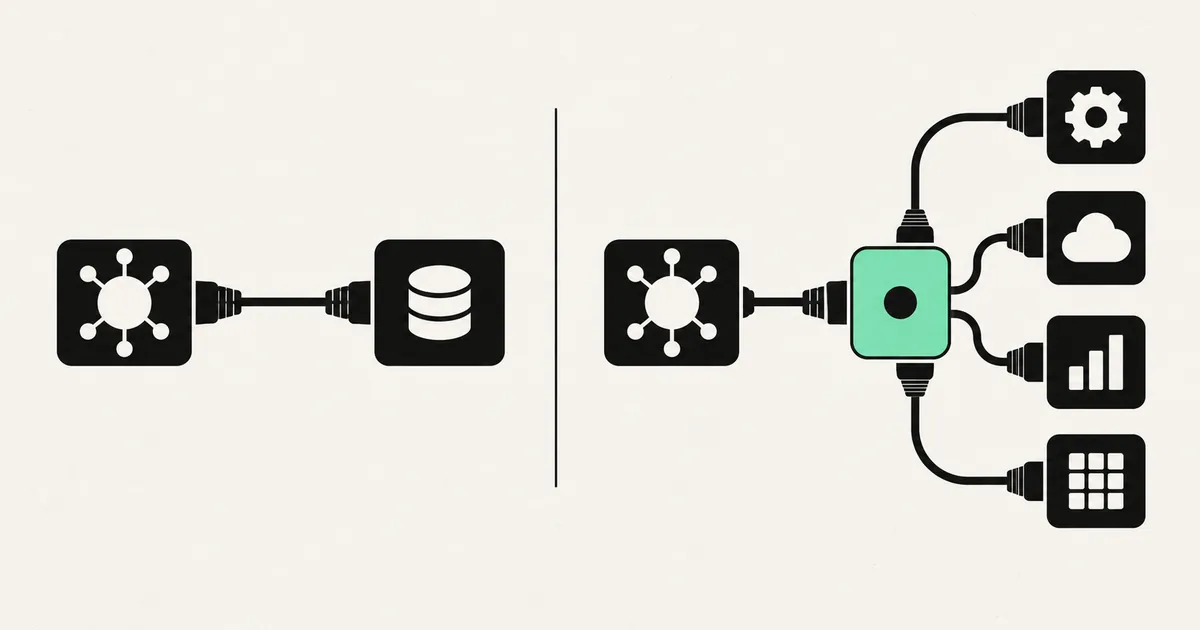
You keep seeing "MCP" next to "API" in AI pitches, and the two words seem to be fighting for the same job. They aren't. An API and an MCP server are not competitors — one usually lives inside the other. But the distinction matters a lot the moment you want an AI agent to actually do things in your business, because picking the wrong mental model leads to either over-engineering or a pile of brittle glue code.
This guide settles the "MCP vs API" question in plain terms: what each one is, how they relate, when your AI project needs one, the other, or both — and why the industry landed on MCP as the standard in 2026.
The one-sentence answer
An API is how any two pieces of software talk to each other. An MCP server is a standardized wrapper around APIs, designed specifically so AI agents can discover and use them safely.
That's the whole thing. An MCP server almost always calls one or more regular APIs under the hood. What it adds is a consistent, model-friendly format that any AI agent can understand without a developer writing bespoke integration code for that specific tool.
So "MCP vs API" is a bit like "USB-C vs electricity." The API is the underlying capability. MCP (Model Context Protocol) is the universal port that makes that capability plug-and-play for AI.
What an API actually is
An API — Application Programming Interface — is a contract. Your Stripe account exposes an API so other software can create charges, list refunds, and read invoices without touching Stripe's internal database directly. Your CRM, your calendar, your database, and nearly every SaaS tool you use all expose APIs.
APIs are brilliant and everywhere, but they share three traits that matter here:
- Every API is different. Different authentication, different data shapes, different naming. Learning one teaches you almost nothing about the next.
- They're built for developers, not models. An API assumes a human programmer read the docs and wrote code to call it exactly right.
- They don't describe themselves to an AI. A raw API endpoint doesn't announce "here's what I can do and what arguments I expect" in a way an AI agent can reliably interpret on its own.
For decades that was fine, because a person always sat between the API and the intent. AI agents remove that person — and that's precisely where the friction shows up.

What an MCP server adds on top
Model Context Protocol is a shared standard for how an AI agent talks to an outside tool or data source. An MCP server wraps a system — say your database or help desk — and exposes it in a uniform way any MCP-compatible AI can consume.
Crucially, the MCP server self-describes. When an agent connects, it asks "what can you do?" and the server replies with a structured list of its tools (actions), resources (readable data), and prompts (reusable templates). The model can then decide, mid-task, to call a tool — and the server does the real work against the real system, usually by calling that system's normal API.
The payoff is the shift from an M×N problem to an M+N problem. Without a standard, connecting M tools to N AI apps means building M×N custom integrations. With MCP, each tool gets one MCP server and each AI app speaks MCP once — they meet in the middle. If you want the full walkthrough, we cover it in what is an MCP server.
MCP vs API, side by side
| Dimension | Raw API | MCP server |
|---|---|---|
| Primary audience | Human developers | AI agents |
| Consistency | Every API is unique | One consistent protocol across tools |
| Self-describing | No — needs docs + code | Yes — advertises its tools/resources |
| Discovery | Developer reads docs | Agent asks "what can you do?" |
| Reuse across AI vendors | Rebuild per integration | Build once, works across vendors |
| What it wraps | The system directly | Usually one or more APIs |
| Best when | Deterministic app-to-app calls | An AI agent needs to act across tools |
Notice the last row. If two systems talk on a fixed, predictable path — your checkout calls your payment API — you don't need MCP at all. MCP earns its place specifically when a reasoning model has to choose which action to take at runtime.
When you need an API, MCP, or both
Most real projects use both, but the trigger for adding MCP is specific.
- API only. Classic software integration with no AI making decisions: a form submits to your backend, a nightly job syncs orders to accounting. Adding MCP here is pure overhead.
- MCP on top of APIs. You want an AI agent to take actions across several systems and decide which action fits the moment — refund an order and email the customer and log a note. The agent speaks MCP; each MCP server calls the underlying APIs.
- MCP for reuse. You expect to connect the same tools to multiple AI apps, or to swap model vendors later without rewiring everything. MCP is what protects that investment, because it's a cross-vendor standard adopted across Anthropic, OpenAI, Google, Microsoft, and AWS.
A simple rule: if a human wrote the exact sequence of calls ahead of time, an API is enough. If an AI decides the sequence at runtime, MCP is the clean way to give it that power. Our piece on AI agent vs chatbot draws the same line from the agent side — "can it act?" is the dividing question.
What this looks like in practice
A recent client project needed an internal assistant that could answer staff questions and take action — pull a customer's history, check open invoices, and place a calendar hold for a follow-up. Every one of those systems already had a perfectly good API. What they lacked was a way for one AI agent to use all of them without us hand-wiring each call and each auth flow. So we stood up a small set of MCP servers — one per system — each wrapping the existing APIs and exposing only a handful of tightly-scoped tools with read/write limits and full logging. The agent orchestrated across them. When the team later wanted to try a different model family, the integrations didn't change at all. That reuse is exactly the difference MCP buys you over raw API wiring, and it's why we increasingly build integrations MCP-first.
The security angle you shouldn't skip
Because an MCP server exposes actions to a reasoning model, it deserves the same care as any account that can touch production data. MCP's fast, universal adoption also drew attackers — through early 2026 the ecosystem saw real issues like tool-poisoning (a malicious server description tricks the model) and prompt-injection through returned data, with several CVEs reported.
This isn't a reason to avoid MCP; it's a reason to build it properly. Give each server the narrowest permissions it needs, keep human approval on destructive actions, and log every tool call. Done right, routing agent access through MCP servers is safer than a tangle of ad-hoc API integrations, because everything flows through one auditable choke point instead of scattered credentials. If you're comparing automation approaches more broadly, RPA vs AI agents is a useful companion read.
Frequently asked questions
Is MCP replacing APIs? No. MCP sits on top of APIs — an MCP server typically calls regular APIs under the hood. What MCP replaces is the pile of custom, one-off integration code you'd otherwise write so each AI app could use each API. The APIs themselves aren't going anywhere.
Do I need an MCP server if I already have an API? Only if you want an AI agent to use that API by deciding when and how to call it at runtime. For fixed, developer-defined software-to-software calls, your API alone is enough. The moment the phrase becomes "the AI should update the CRM," MCP is the clean path.
What's the difference between an MCP server and an API wrapper? A plain API wrapper is still bespoke — it works for the one app you wrote it for. An MCP server follows a shared, vendor-neutral standard, so it self-describes its capabilities and works across any MCP-compatible AI without new integration code. That standardization is the whole point.
Is MCP an Anthropic-only technology? No. MCP originated at Anthropic but is now a vendor-neutral open standard governed under the Linux Foundation, and it's supported across Anthropic, OpenAI, Google, Microsoft, and AWS. What you build to the standard works across compatible platforms.
Trying to figure out whether your AI project needs a custom MCP server or just clean API work? SprintX scopes and builds both — production-ready MCP servers and agent integrations with tightly-scoped permissions, full logging, and a definition of done that means "works in production," not "works in a demo." Tell us what you want your agents to do and we'll quote it as a fixed-price milestone, with the code yours to keep. If a full build is on the table, our guide to custom MCP server development covers what that project involves.
AI agents and automation
AI agents that do the work.
We build agents and automations for the repetitive work your team does by hand, and measure what they save.
Keep reading.
More on ai agents and automation
AI agents and automation · 18 Jul 2026 · 8 min read
What Is an MCP Server? A Plain-English Guide for Businesses (2026)
A no-jargon guide to MCP servers: what they are, why every major AI vendor adopted them, and how businesses use them to connect AI agents to real systems.
AI agents and automation · 18 Jul 2026 · 9 min read
Postgres MCP Server: Let AI Query Your Database Safely
A practical guide to running a Postgres MCP server so AI agents can query your database without turning into a security incident.

AI agents and automation · 18 Jul 2026 · 9 min read
Custom MCP Server Development: Expose Your Business Data to AI Agents
A practical guide to custom MCP server development — what it takes to expose your own systems to AI agents safely, the build process, cost ranges, and pitfalls.